About Colias croceus (Geoffroy, 1785)
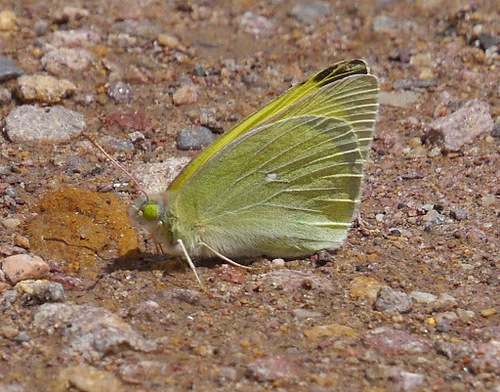
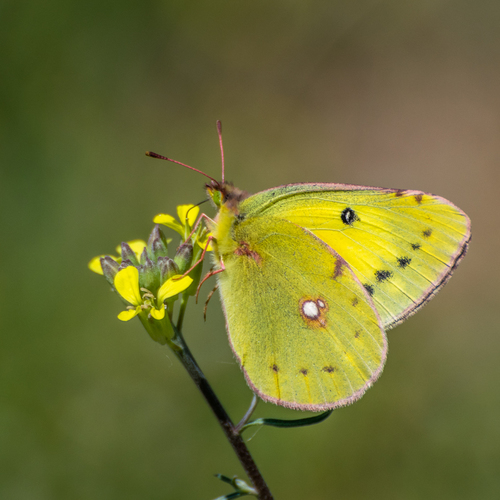
Colias croceus has a wingspan of 45–54 millimetres (1.8–2.1 in). The upperside of its wings is golden to orange yellow, with a broad black margin along all four wings and a black spot near the center of the forewing. These butterflies usually settle with their wings closed, so the black margin of the wing uppersides is difficult to see. The wing underside lacks black borders, is lighter in color, and has a more greenish tint, especially on the forewings. The underside of the forewing has the same dark spot as the upperside, but this spot often has a light center. The underside of the hindwing has a white center spot, which usually has a smaller white or dark dot directly above it. Sometimes, a row of black dots appears along the outer margins of the underwings, aligned with where the black border ends on the upperside. Females differ from males by having yellow spots along the black borders of the wing uppersides. In flight, Colias croceus is easily recognized by its intense yellow coloring, which is much brighter than the lemon-yellow of male common brimstones, which also lack black markings. Like all species in the Colias genus, Colias croceus never opens its wings when at rest. Around 5% of females have pale cream coloration on the wing upperside instead of the typical golden color. This pale variant is classified as form helice. The pale helice form does not appear to be a fully distinct subspecies, as intermediate forms exist, and the color variation is partially tied to developmental humidity: drier conditions produce paler coloration. Pale helice individuals can be confused with Berger's clouded yellow (Colias alfacariensis) and the rarer pale clouded yellow (Colias hyale). However, even the palest C. croceus usually has more black on the wing upperside, particularly on the hindwings. Young caterpillars are yellow-green with a black head. After the third moult, older caterpillars become entirely dark green and develop a white lateral line marked with red spots. The pupae are green with a yellow side stripe. This species is similar in appearance to Colias myrmidone, Colias chrysotheme, Colias erate, Colias hyale, Colias alfacariensis, Colias caucasica, and Colias aurorina. Colias croceus (common clouded yellow) is one of the most widespread butterfly species in Europe. Its permanent breeding range covers North Africa, southern Europe, and extends eastward through Turkey into the Middle East. It occurs across most of Europe as a summer migrant, and in years with large populations, individuals can reach as far north as Scandinavia. In Asia, its range extends north into central Siberia and just reaches India in the south; it is not present in Central Asia. In the United Kingdom, this species is primarily an immigrant, with individuals originating from southern Europe and northern Africa. It can be seen on the UK's south coast almost every year in varying numbers, and breeds there regularly. Occurrence across the rest of the UK varies greatly from year to year, but the species is increasingly observed as far north as Dumfries and Galloway. It has also been recorded in Ireland, ranging from Raven, County Wexford to Belfast, County Down. As a truly migratory European butterfly, this species is known for occasional mass migrations followed by breeding, events that are called "clouded yellow years" in the United Kingdom. Notable clouded yellow years include 1877, 1947, 1983, 1992, 1994, 1996, and 2000. These butterflies can live in any open rural area, including downland, coastal cliffs, and fields that host the caterpillar's host plants, at elevations up to 1,600 metres (5,200 ft) above sea level. Adult Colias croceus fly from March to October. In southern Europe and North Africa, they breed continuously year-round. Females lay eggs singly on the leaves of food plants. A single female can lay an unusually large number of eggs, up to 600. Caterpillars grow quickly in warm weather, and sometimes pupate within a month. Caterpillars go through 4 moults in total. The pupa stays attached to a foodplant stem held by a silk girdle. Pupation lasts two to three weeks, and in favorable years there can be up to three generations per year, with adults still flying at the beginning of November. Larvae feed on a variety of leguminous plants in the subfamily Faboideae, including Trifolium pratense, multiple Medicago species, and species in the genera Vicia, Lotus, Onobrychis, Astragalus, Colutea arborescens, Hippocrepis, and Anthyllis. In the UK, wild and cultivated clovers (Trifolium) and alfalfa (Medicago sativa) are preferred; common bird's-foot trefoil (Lotus corniculatus) is eaten less frequently. Adults feed primarily on nectar from thistles (Cirsium spp. and Carduus spp.), knapweeds (Centaurea spp.), dandelion (Taraxacum), fleabane (Pulicaria dysenterica), marjoram (Origanum vulgare), ragwort (Senecio jacobaea), and vetches (Vicia spp.).