About Coleanthus subtilis (Tratt.) Seidel ex Roem. & Schult.
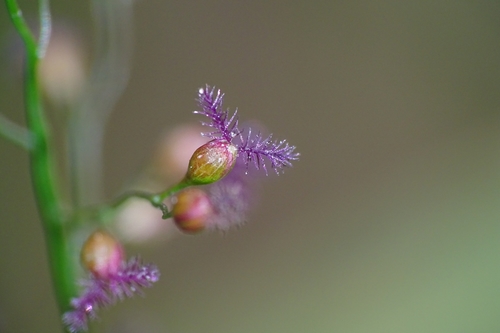
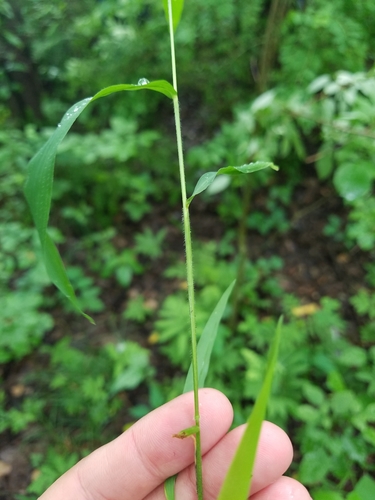
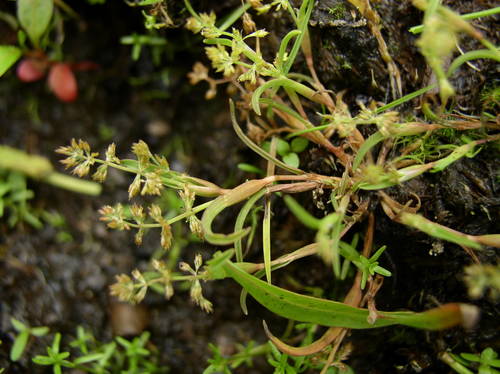
Coleanthus subtilis (Tratt.) Seidel ex Roem. & Schult. is a small, clump-forming annual grass that typically grows prostrate along the ground. Its culms are thin, either prostrate or ascending, have two to three nodes, a shallow groove, and reach 30 to 80 mm in length. Leaf sheaths are glabrous and closed along their lower half; the uppermost leaf sheath is especially strongly inflated. Ligules form a membranous scaly fringe between 0.5 and 0.8 mm long. Glabrous leaf blades measure 10 to 20 mm long and 1 to 2 mm wide, are weakly grooved, folded, and often sickle-shaped. The panicle ranges from 10 to 30 mm in size, and is made up of several more or less dense clusters of spikes arranged in tufts. Spikelets are single-flowered, 0.8 to 1.2 mm long, and remain attached to the panicle even after seed ripening. Glumes are absent. The thin-skinned lemmas are single-nerved, 0.8 to 1.2 mm long. All nerves are hairless except the median nerve, which has short, protruding hairs. Lemmas have an oval lower portion, an extended upper portion, and a narrowly rounded or awn-pointed tip. The two-nerved, glabrous, thin-skinned bracteoles are 0.4 to 0.6 mm long, with wide depressed sides and four points at the top; each of the two nerves ends in a short tip. This species produces a pair of stamens; filaments attach to the base of the anthers, which are approximately 0.3 mm long. The stigmas of the ovary are thread-like and protrude from the upper end of the flower. Fruits are 0.6 to 0.8 mm long, wrinkled, protrude between the upper and front husk, and dislodge on their own without external force. Coleanthus subtilis typically flowers from June to September, with very rare occurrences in early May or late November. It is a diploid species, with a chromosome number of 2n = 14. Its distribution covers several small, highly disjunct sub-areas: Northwest France (Brittany); Central Europe, where it occurs primarily in the Czech Republic (with around 140 former localities), and extends to Austria (only at some ponds in the Waldviertel, threatened with extinction), Slovakia, and Poland near Wrocław. In Germany, it is extinct in the Westerwald (Rhineland-Palatinate) and near Mannheim (Baden-Württemberg), but has recently been found in Freiberg and Upper Lusatia (Saxony), and near Wittenberg (Saxony-Anhalt). It is now extinct in South Tyrol, where it formerly grew at two lakes near Bolzano and at Lake Dobbiaco. In Norway, the last recorded occurrence was near Oslo in 1842. Additional distribution locations include the area south of Lake Ladoga near Saint Petersburg, West Siberia, the middle and lower Amur in China, and six areas in southern British Columbia (Canada) and along the Columbia River in Washington and Oregon (USA) in North America. A population was discovered in Canada's Northwest Territories in 2007, approximately 1700 km from the nearest known site. Because the species was only discovered in North America in 1880, it was originally thought to have been introduced from Europe. However, multiple lines of evidence suggest it is also native to North America: it has very specialized habitat requirements, its rarity likely led to its late discovery in the region, and there is no circumstantial evidence confirming an introduction from Europe. Coleanthus subtilis is listed in Annex II and IV of the Habitats Directive, and is therefore classified as a priority species. Due to its endangered status, it receives special protection in Germany under the Federal Species Protection Ordinance. Coleanthus subtilis is a therophyte with a six to seven-week life cycle. It generally grows in short-lived, patchy dwarf rush colonies that cover 60–80% of available space. It occurs in widely scattered locations, most often on the mud of drained ponds, stream and river banks, and old-water margins. The species is extremely rare and unstable, and disappears as soon as the ground floods again. Under ideal conditions, it has a lifespan of two to four years. Older research notes that seeds can survive in flooded soil for up to 20 years without losing germination ability. Seeds are dispersed over relatively short distances by rivers (hydrochory), and by waterfowl and swamp birds (zoochory). Seed dispersal by wild ducks may explain the highly disjunct distribution of populations across the Bohemian Massif, Saint Petersburg, and Siberia. It is most commonly found in the Cypero-Limoselletum of the Nanocyperion association.