About Colaptes rupicola d'Orbigny, 1840
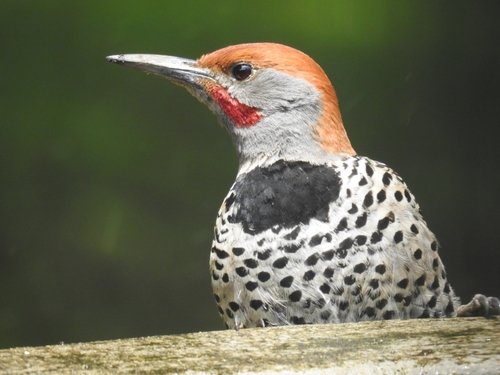
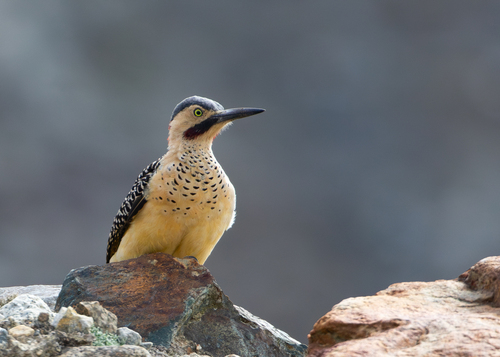
The Andean flicker (Colaptes rupicola d'Orbigny, 1840) is approximately 32 cm (13 in) long. Males and females share the same plumage pattern, with the only differences appearing on their heads. For adult males of the nominate subspecies, the area from the forehead to the hindneck is dark slate gray; the hindneck very occasionally has a faint hint of red. The face, chin, and throat are pale buffy white, marked with a thin black malar stripe that has red tips on the feathers. Adult females have an entirely black malar stripe, and never have any red on the hindneck. The upperparts of both sexes are barred with brown, light brown, and buffy white. Their uppertail coverts are white with narrow dark bars. Their flight feathers are dark brown with narrow pale buff bars. The upperside of the tail is black; the central and outermost tail feathers have thin paler bars. The underside of the tail is dark brown, and sometimes has a yellowish tint along the outer edge. The underparts are whitish, with a variable orange-buff wash on the breast, plus small blackish marks on the breast and sometimes on the flanks. The species' long bill is black, the iris is lemon yellow, and the legs are yellowish gray, greenish, or grayish pink. Juveniles are duller in color than adults, have pale blue or reddish brown eyes, and have buff tips on the rear crown feathers. Their underparts have bar-like patterns rather than the spots seen on adults. Juvenile males usually have some red on the nape. The subspecies C. r. puna is similar to the nominate subspecies, but is darker on both its upperparts and underparts. Its breast markings are larger, its tail is usually less barred, and its legs are dull greenish. The female's malar stripe is often indistinct, and both sexes have a dark red patch on the hindneck. The subspecies C. r. cinereicapillus differs significantly from the nominate subspecies. Its face, throat, and breast are rich tan-buff, its belly and rump are yellow-buff, and its breast has black bars rather than black spots. It has no red on the nape, and the red tips on its malar feathers only appear on the few rearmost feathers, rather than on all of the malar stripe. Of the Andean flicker subspecies, C. r. cinereicapillus has the northernmost range. It is found from Loja Province in extreme southern Ecuador, south into central Peru as far as the departments of Pasco and Junín. C. r. puna occurs in central and southern Peru. The nominate C. r. rupicola is found from Tarapacá Region in northern Chile, through western, southern, and central Bolivia, and into northwestern Argentina as far as Catamarca Province. The Andean flicker is a bird of open country. It inhabits páramo, puna, Polylepis woodland, montane scrublands, and other mixed landscapes of rock, grass, and scattered higher vegetation. It uses rocks, cliffs, and trees as lookout points. Its elevation range is between 2,000 and 5,000 m (6,600 and 16,400 ft), but it most often occurs above 3,000 m (9,800 ft). The few recorded observations of the species below this elevation are thought to involve non-breeding adults roaming to forage.