About Colaptes rubiginosus (Swainson, 1820)
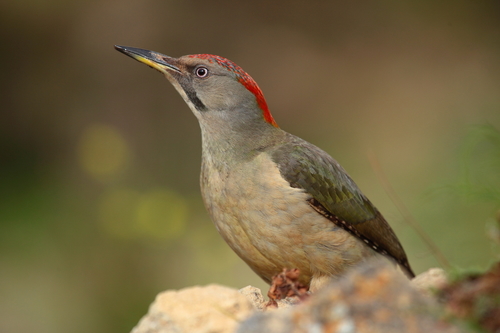
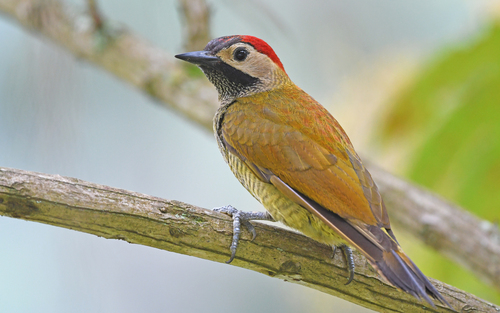
Golden-olive woodpecker (Colaptes rubiginosus, first described by Swainson in 1820) measures 18 to 23 cm (7.1 to 9.1 in) in length. Males and females have identical plumage except for the coloration of their heads. For the nominate subspecies C. r. rubiginosus, adult males have a slate gray forehead and crown, with a red border and red nape. The area from their lores, around the eye, to the red nape is pale buff to whitish. They have a wide red malar stripe, plus pale buffy white chin and upper throat; the throat has heavy blackish streaks. Adult females only have red on their nape, and their malar area has streaking matching that of the throat. Both sexes of the nominate subspecies have mostly green upperparts with a bronze tinge; their rump and uppertail coverts are paler and barred with dark olive. Their flight feathers are dark brownish olive with greenish edges and some yellowish coloring on the shafts. Their tail is brown. Their underparts are pale buffy yellow with blackish olive bars; the bars are closest together on the chest. This woodpecker has a medium-length bill that is slaty gray to black, a deep dull red iris, and gray to olive-gray legs. Juveniles are generally duller than adults and have less well-defined underpart barring. Other subspecies of golden-olive woodpecker differ from the nominate in size, back color, and the underparts' base color and barring. These differences compared to the nominate are as follows: C. r. yucatanensis is larger but variable, with lighter breast barring; C. r. alleni is large, has bronze-gold upperparts with red tinges, a black throat with white spots, narrow breast bars, and red on the male's crown; C. r. buenavistae is very large, has a bronzy back with reddish tinge, darkly barred rump, and olive green bars on underparts; C. r. meridensis resembles buenavistae but is somewhat smaller with a less bronzy back; C. r. deltanus is small, has a greener back, and larger white spots on the throat; C. r. paraquensis is large, has a strong bronze tinge on the back, and a dark dark gray crown with very little red; C. r. guianae is large, has a bronzy yellow-green back, very small pale throat spots, and a moderate amount of red on the crown; C. r. viridissimus is very large, has a bright yellow-green back, whitish base color and wide black barring on the breast, and males have less red on the head; C. r. nigriceps resembles guianae but has little or no bronze; C. r. trinitatis resembles tobagensis but is much smaller with a less heavy bill; C. r. tobagensis is large, has bronze-gold upperparts with red tinges, a black throat with white spots, and medium-width greenish bars on the breast; C. r. gularis is large, has fine white throat spots and pale underparts; males have an entirely red crown, and females have slightly less red; C. r. rubripileus resembles gularis but is smaller with blacker breast barring; C. r. coloratus has slightly bronzy upperparts, a bright yellow mostly unbarred belly, and barred flanks; C. r. chrysogaster has a very bronzy back with red tinge and an unbarred yellow belly; males have a large amount of red on the crown; C. r. canipileus has a very bronzy back with red tinge and a lightly barred yellow belly; males have a large amount of red on the crown; C. r. tucumanus is large, has a dull green, less bronzy back, and whiter underparts with blackish barring. The golden-olive woodpecker inhabits a very wide variety of landscapes, most of which are semi-open to dense. Its range includes environments from dry tropical thornscrubs to humid rainforests; between these two extremes are cloudforests, oak-pine woodland, dry deciduous forests, riparian thickets, and mangroves. It is also frequently found along forest edges, in scattered trees within clearings, and in shade-grown coffee plantations. In terms of elevation range, the species occurs from near sea level to 2,100 m (6,900 ft) in Mexico, between 750 and 2,150 m (2,500 and 7,100 ft) in Central America, from sea level to 2,800 m (9,200 ft) (most commonly between 350 and 2,100 m (1,100 and 6,900 ft)) in Venezuela, between 900 and 3,100 m (3,000 and 10,200 ft) in Colombia, between 1,000 and 2,500 m (3,300 and 8,200 ft) in Argentina, and up to 2,300 m (7,500 ft) in Ecuador, Peru, and Bolivia.