About Colaptes pitius (Molina, 1782)
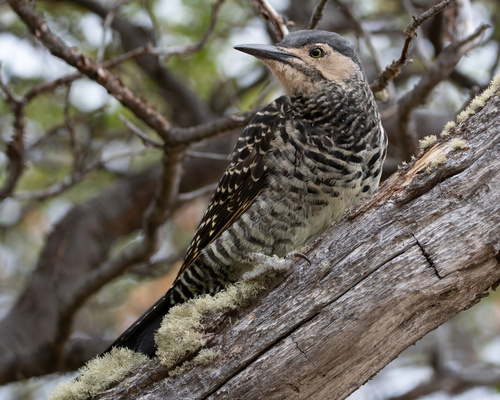
The Chilean flicker (Colaptes pitius) is approximately 30 cm (12 in) long and weighs 100 to 163 g (3.5 to 5.7 oz). Males and females share identical plumage across most of their bodies, differing only in head plumage. Adult males have dark slate gray coloration from the forehead to the nape, with an occasional faint hint of red on the nape. The area from the lores, around the eye, extending to the nape is buffish, and the malar region has fine black or black-and-red spots that form a diffuse patch. Their chin and throat are buffish white, with black spots on the lower throat. Adult females have a buffish malar area with no spots, and they never have red on the nape. Both sexes have blackish brown upperparts marked with narrow white to buff-white bars. Their rump is white, sometimes with a small number of black spots. Their flight feathers are dark brown with pale shafts. The upper side of their tail is brown-black, with narrow white bars on the central and outermost feathers. The underside of their tail is yellowish with poorly defined bars. Their underparts are whitish, with wide blackish brown bars on the breast and a mostly unmarked belly. Their moderately long bill is black, their iris ranges from whitish to yellowish, and their legs range from gray to green-gray. Juveniles resemble adults, but have brown eyes, a blacker crown, wider bars on their upperparts, and more spots on their underparts. The Chilean flicker is distributed in central and southern Chile, ranging from the Coquimbo Region to the central Magallanes Region, and in adjacent southwestern Argentina between the provinces of Neuquén and Santa Cruz. It lives in temperate and Mediterranean climate zones, where it prefers semi-open to open landscapes, including forest edges and forest openings, open woodlands, riparian woodland, tree plantations, and scrublands. Most individuals occur between elevations of 600 and 1,000 m (2,000 and 3,300 ft), though the species can be found near sea level during winter.