About Colaptes melanochloros (J.F.Gmelin, 1788)
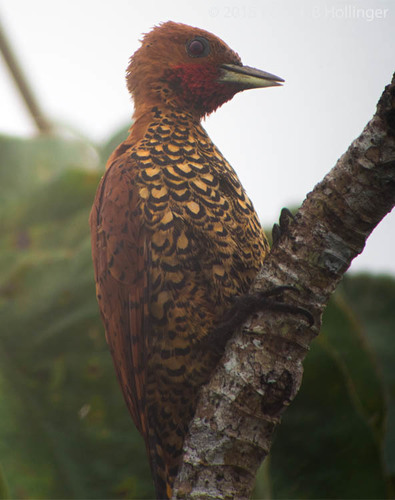
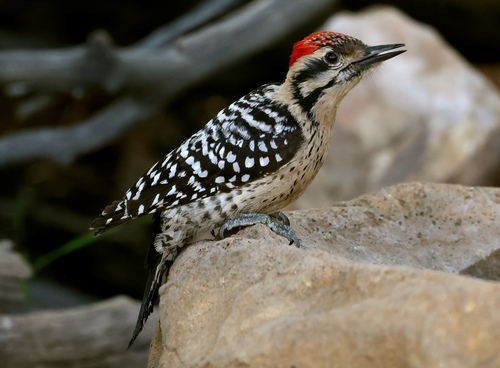
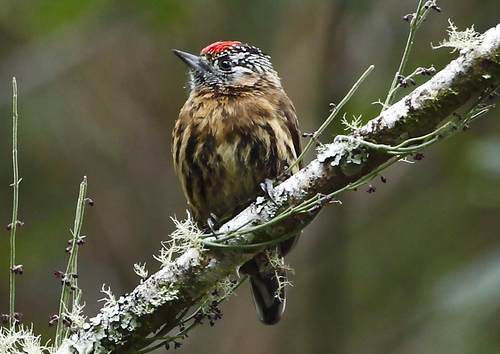
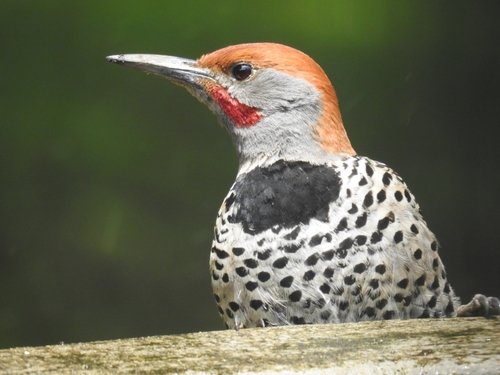
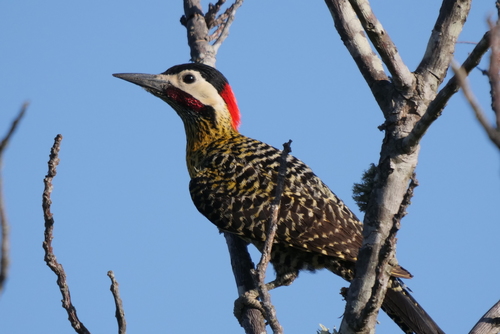
The green-barred woodpecker (Colaptes melanochloros) is 27 to 30 cm (11 to 12 in) long and weighs 80 to 178 g (2.8 to 6.3 oz). Males and females have identical plumage except on the head. For the nominate subspecies C. m. melanochloros, adult males have a black forehead and forecrown, and a red hindcrown and nape. A white area extends from the lores around the eye to the nape, with a red malar stripe below it, and their ear coverts have a strong olive tinge. Their chin and throat are whitish green with black streaks. Adult females only have red on the hindcrown and nape, and their malar is black with white streaks. Both sexes of the nominate subspecies have yellowish green upperparts marked with dark brown bars. The rump is paler and less heavily barred, and the uppertail coverts are buff with black bars. Their flight feathers are greenish brown with pale barring and olive shafts. The upper side of the tail is black, and the outer tail feathers have pale bars. The underside of the tail is black with yellowish bars. Their underparts are pale green, usually darker on the breast, with black spots on the breast, lower breast, and flanks, but usually no spots on the belly. Their moderately long bill is black, the iris is brown to chestnut-brown, and the legs are gray, usually with a greenish or yellow tinge. Subspecies C. m. nattereri is similar to the nominate, but smaller with a shorter bill. Its plumage is more yellow, and the spots on its underparts are very small or streaky. These two subspecies are not fully distinct, and their plumages intergrade widely. C. m. melanolaimus is more greenish on the upperparts than the nominate, with less spotting on the rump and less barring on the tail. It has black markings on the side of the throat, and its breast has a golden tinge. C. m. nigroviridis is similar to C. m. melanolaimus, but is even more greenish on the upperparts. Its tail is more strongly barred, its breast is less golden, and the spots on its underparts are larger. C. m. leucofrenatus is the largest and most distinctive subspecies. It is brown to golden brown on the upperparts with whitish barring and a white rump. Its breast is golden to orange, its flanks are strongly barred, and it has large or arrowhead-shaped spots on the underparts. The three last-mentioned subspecies also intergrade, but less widely than the two "green-barred" subspecies. The green-barred woodpecker’s call is a "kwiek-kwik-kwik". It also produces a variety of other notes, given singly or in series: peah, krrew, and peek, plus "a screechy wheéo, krrew, pikwarrr, or ker wick." Both sexes drum in "short rolls", but do not drum frequently. The species’ subspecies have the following distribution ranges: C. m. melanochloros occurs in southern and southeastern Brazil, southeastern Paraguay, far northeastern Argentina, and most of Uruguay. C. m. nattereri is found from northeastern and south-central Brazil south into eastern Bolivia. C. m. melanolaimus is found in central and southern Bolivia. C. m. nigroviridis occurs in southern Bolivia, western Paraguay, northern and eastern Argentina, and western Uruguay. C. m. leucofrenatus is found in northwestern and west-central Argentina. Note that the published species map only includes the two "green-barred" subspecies C. m. melanochloros and C. m. nattereri. The green-barred woodpecker lives in a wide range of landscapes, from dry desert scrub to subtropical humid forest. Subspecies C. m. melanochloros occurs mostly in semi-open to open terrain such as savanna, open woodland, and arid brushland. The other subspecies, especially the more northerly ones, are also found in less open lowland forests. The species generally inhabits lowlands and foothills, but can be found up to 3,000 m (9,800 ft) in elevation in Bolivia. As far as is currently known, the green-barred woodpecker is a year-round resident across most of its range. The southernmost population is at least partly migratory, moving north after the breeding season.