About Colaptes chrysoides (Malherbe, 1852)
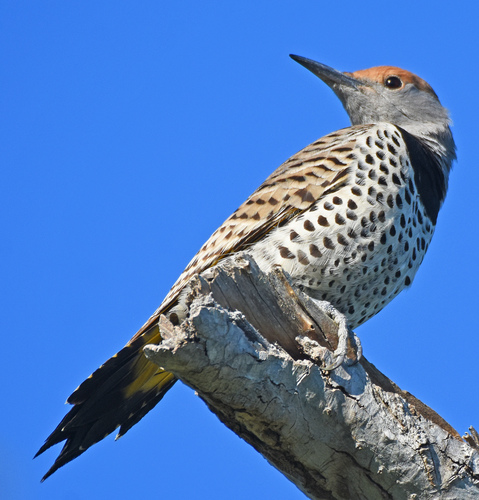
The gilded flicker (Colaptes chrysoides) is a large woodpecker with an average length of 29 centimeters (11 inches). It lives in the Sonoran, Yuma, and eastern Colorado Desert regions of the Southwestern United States and northwestern Mexico, including almost the entire Baja California peninsula, with the only exception being the extreme northwestern part of the peninsula. Yellow underwings set the gilded flicker apart from the related northern flicker (Colaptes auratus), which shares the same region and has red underwings. Gilded flickers most often build their nest holes in saguaro cacti (Carnegiea gigantea), excavating these holes closer to the top of the saguaro than to the ground. Less often, they nest in desert dry washes that have Frémont's cottonwood trees (Populus fremontii) or willows (Salix sp.). Gilded flickers excavate cavities in saguaros one full year before they actually move into the cavities to nest. The saguaro protects itself from losing water into the new nesting cavity by secreting sap that hardens into a waterproof structure called a saguaro boot. In contrast to gilded flickers, northern flickers nest in riparian trees and very rarely use saguaros for nesting. Gilded flickers will occasionally hybridize with northern flickers in the narrow zones where the two species' ranges and habitats overlap.