About Colaptes atricollis (Malherbe, 1850)
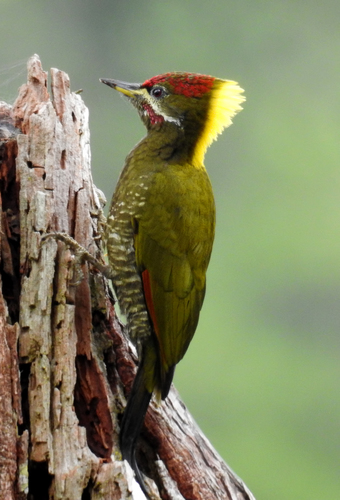
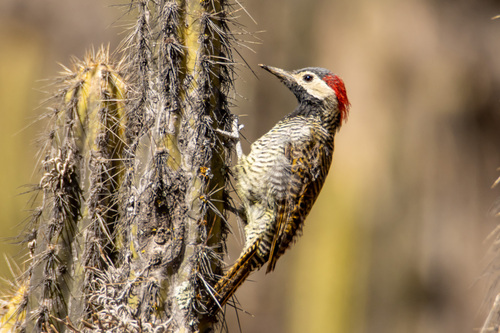
The black-necked woodpecker (Colaptes atricollis, first described by Malherbe in 1850) measures 26 to 27 cm (10 to 11 in) in length and weighs 73 to 90 g (2.6 to 3.2 oz). Males and females share the same plumage pattern except for markings on the head. For the nominate subspecies, adult males have dark gray coloration from the forehead to the forecrown, and red coloration on the hindcrown and upper nape; the gray area often has red feather tips. A yellowish white stripe runs from the lores, around the eye, and extends to the nape, with a red malar stripe below this stripe, and the chin and throat are black. Adult females have red only on the hindcrown, and their malar stripe is blackish. Both sexes of the nominate subspecies have bronze-green upperparts with narrow blackish bars; both the bronze-green and blackish colors are paler on the rump and uppertail coverts. Their flight feathers are dark brown with yellowish barring and olive-yellow shafts. Their tail is dark brown; the central tail feathers and the outer web of the outermost pair of tail feathers have paler barring. Their breast is black, and the rest of their underparts are pale yellow with black bars. They have a longish bill that is black with a paler base, a brown to chestnut-brown iris, and green-gray legs. Juveniles are generally duller than adults and have a darker face; the top of their head is often red with dark bars, their malar stripe has a mix of black and red, and the barring on both their upper- and underparts is more diffuse. The subspecies C. a. peruvianus is smaller than the nominate subspecies and has a shorter bill. Its upperparts are paler than the nominate's but have heavier barring, and its underparts are both paler and have less extensive barring. The nominate subspecies of black-necked woodpecker is found on the west slope of the Peruvian Andes, between the departments of La Libertad and Tacna. Subspecies C. a. peruvianus is found on the east slope of Peru's Andes, from the Marañón River valley south into Huánuco Department. This species lives in a variety of semi-arid to arid landscapes, including drier cloudforest, montane scrublands with cacti, desert scrublands, and deciduous woodlands. It can also be found in riparian woodlands, orchards, plantations, and gardens. On the western slope of the Andes, it mostly occurs at elevations between 500 and 2,800 m (1,600 and 9,200 ft), and is found locally as high as 4,000 m (13,100 ft). In the Marañón Valley, it occurs between 1,700 and 4,300 m (5,600 and 14,100 ft).