About Coenonympha dorus Esper, 1782
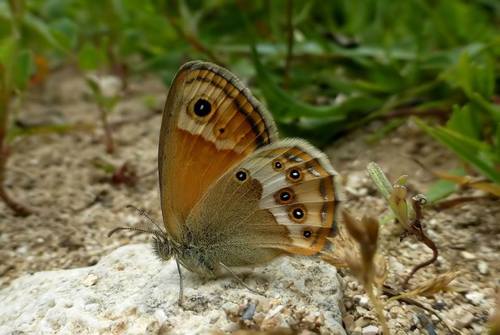
Coenonympha dorus (Esper, 1782), commonly called the dusky heath, is a butterfly species in the Nymphalidae family. It is found in south-western Europe and North Africa. The forewings of this butterfly measure 16–17 mm in length.
In Seitz's description of C. dorus Esp. (synonymized with dorilis Bkh. and dorion Hbn., specimen plate 48 f): Males are entirely shaded with soot-colour on their upperside, except the posterior portion of the hindwing disc. Females are reddish yellow, with a broad black apex and black distal margin on both wings. The upperside of the hindwing bears a curved row of ocelli that is convex toward the proximal end; this row of ocelli is very irregular on the underside. The species is not rare in stony habitats across South France, Spain, Portugal, and Italy, and flies in June and July.
Several forms and aberrations of the species have been described: The form austauti Oberth. is currently classified as the subspecies C. d. austauti Oberthür, 1881. It has ochre-yellow smears on the upperside of the forewing, and the white band on the underside of the hindwing is much more prominent; it occurs in western Algeria. The form bieli Stgr. from Portugal has strongly sooty-coloured hindwing uppersides in both sexes, with nearly all reddish yellow colouring gone from the disc. The ocelli and metallic line on the underside of the hindwing are both strongly reduced. The form andalusica Ribbe also has strongly reduced ocelli on the underside of the hindwing, but the upperside, especially of females, remains a bright clay-colour; it occurs in South Spain. The aberration ab. caeca Oberth. (specimen plate 48 f) from the Pyrenees has ocelli completely absent from the underside, but the light distal band is still present as a unicoloured area. For the aberration ab. fulvia Oberth. from Lozère, the ocelli are fully developed, but there is no light scaling around them, so they lie directly against the wing's ground colour.
Little is confirmed about the dorus larva: Ruhl has reported that larvae feed on bent-grass (Agrostis). Adult dusky heath butterflies are on the wing from June to August. Overall, larvae feed on various species of grasses.