About Coenonympha arcania Linnaeus, 1761
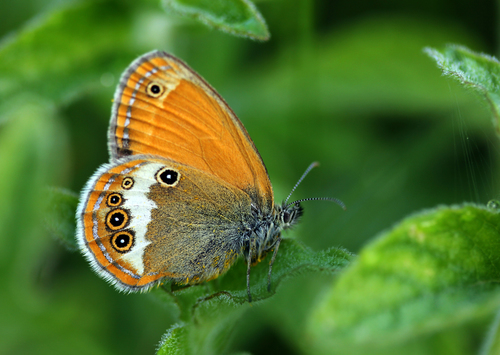
This species, scientifically named Coenonympha arcania Linnaeus, 1761, resembles Coenonympha hero. Seitz's description is as follows: C. arcania L. (48 d). The forewing is fiery reddish yellow with a black distal margin, and the hindwing is dark brown. It is easily recognizable by the underside of the hindwing, where a broad white band occupies the marginal portion. In the nymotypical form, this band interrupts the row of ocelli below the apical eye, so the apical eye appears placed on the inside of the white band. It is distributed across all Europe except Great Britain, ranging from Scandinavia to the Mediterranean Sea, and from Spain and France to the Black Sea and Armenia; it is also specifically noted to occur in Central Europe and Scandinavia. Specimens with a very broadly black margin on the forewing, and a narrowed, slightly dentate band on the underside of the hindwing are classified as ab. insubrica Frey (variety) (48 d). These specimens likely occur among nymotypical specimens everywhere, but are especially common in the South. The larva is green with a dark dorsal stripe bordered by a yellowish tint, a light subdorsal stripe, and a pale yellow lateral stripe. Its head is blue-green, while the mouth and anal fork are red. Larvae develop on grasses until May. The pupa is brown, with whitish wing-cases edged in red. Adult butterflies are very common in June and July, and often fly together in large numbers. They inhabit woodland edges with abundant undergrowth, and also occur in open country and on hills. They typically fly around bushes and rest on the tips of low twigs, but sometimes fly up into the higher branches of trees. Females are much less numerous than males and emerge later.