About Coenogonium pineti (Ach.) Lücking & Lumbsch
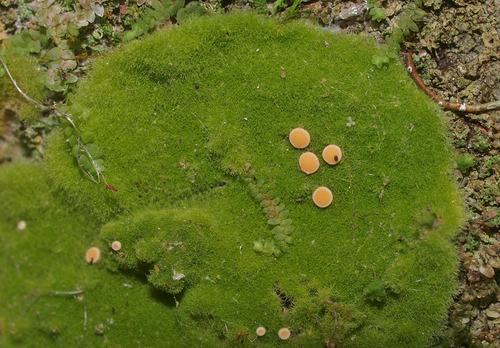
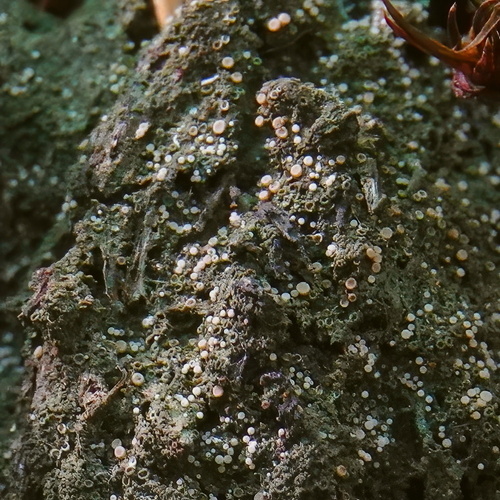
Coenogonium pineti (Ach.) Lücking & Lumbsch is a crustose lichen species belonging to the family Coenogoniaceae. Erik Acharius first formally described this species in 1810 under the name Lecidea pineti. In 2004, Robert Lücking and H. Thorsten Lumbsch transferred the species to the genus Coenogonium, after molecular phylogenetic analysis indicated it belonged to this genus. This lichen is broadly distributed across cooler, temperate areas of the Northern Hemisphere, and it has also been documented in southeastern mainland Australia and Tasmania. It most commonly grows on bark, but it has also been observed growing on mosses. Its thallus is smooth, ranges in colour from greyish-green to greenish-black, does not have a prothallus, and grows to a diameter of 5–20 mm (0.2–0.8 in). The apothecia are small, measuring 0.2–0.5 mm in diameter, are pale in colour, and have a wide margin. The ascospores are ellipsoid, have a single septum, and measure 9–14 by 2.3–4.5 μm. Preliminary molecular analysis has revealed that the traditional classification of Coenogonium pineti encompasses distinct genetic lineages, which suggests that cryptic species exist within this group.