About Coenobita rugosus H.Milne-Edwards, 1837
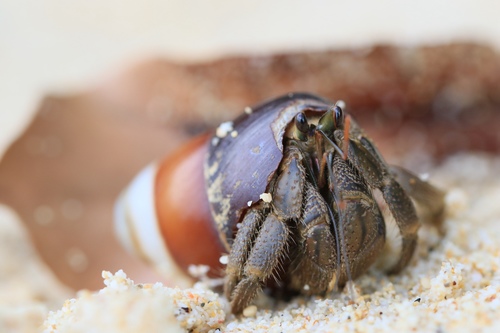
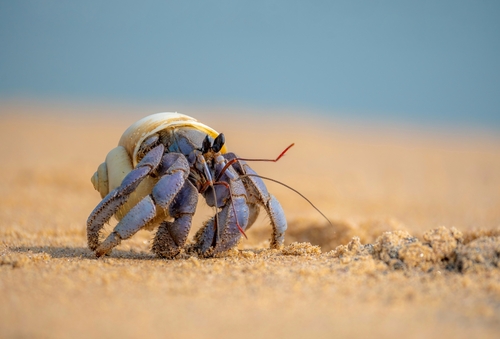
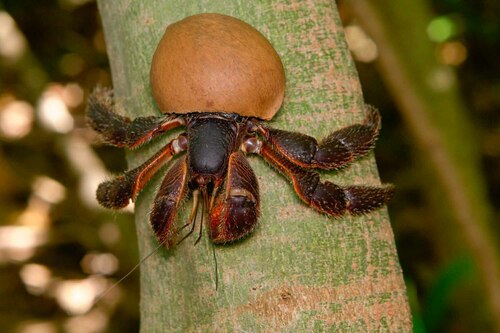
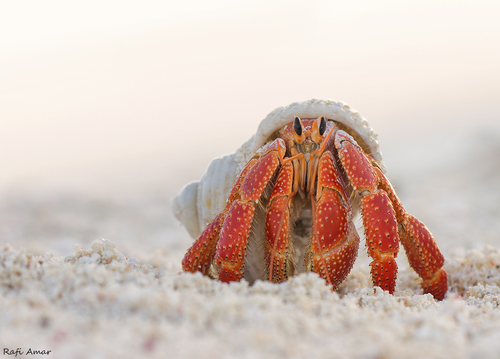
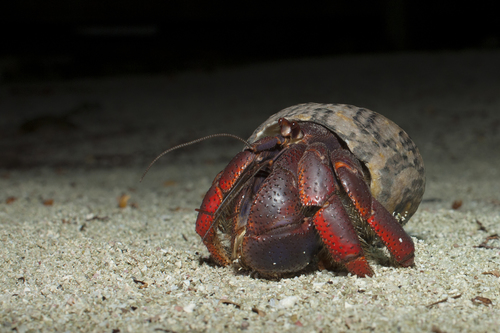
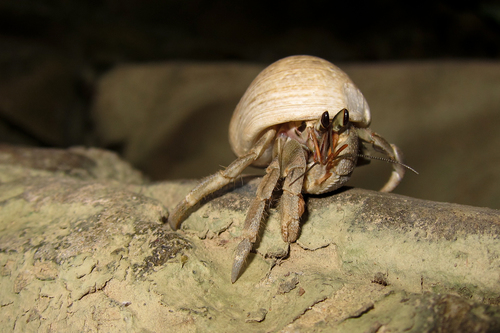
Coenobita rugosus is a species of land hermit crab, originally described by H. Milne-Edwards in 1837. Its native range extends from Indonesia, Australia, and the east African coast to the southwestern Pacific. This hermit crab has four walking legs, one small pincer, one large pincer, and antennae. When threatened, C. rugosus produces a chirping sound by rubbing its large pincer against its shell, which acts as a stridulatory apparatus. The species varies in colour based on nutritional intake. Common colours for C. rugosus are green, brown, and tan, though black, white, pink, and blue individuals have also been observed. This species can be distinguished from other land hermit crabs by the prominent striations, also called stitch marks, on its large pincer. Two other species, Coenobita compressus and Coenobita perlatus, have these striations but to a much smaller degree. These two species can be easily told apart from C. rugosus by size and colour, this is especially true for adult C. perlatus, which have a distinctive bright red colouration. Adult C. rugosus can reach a length of 15 centimetres (5.9 inches). Their eyestalks are sandy-coloured, and may have a brown stripe along their lower edge. The lower segment of the second antenna is light orange. The large pincer has 7 ridges along its upper section, and fine hair typically grows on the inner surface of both pincers. The second segment of the last pair of walking legs is flattened and paler in colour than surrounding tissue. C. rugosus has a short, fat abdomen. Like other land hermit crab species, C. rugosus is a scavenger that feeds on plants, dead fish, fruit, and other detritus.