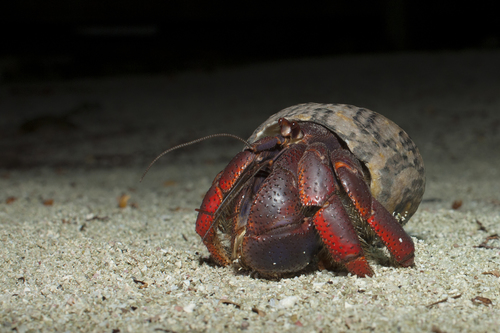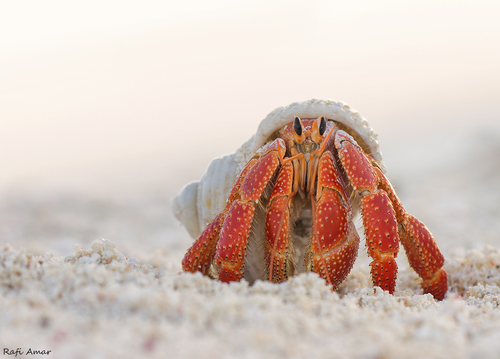
About Coenobita perlatus H.Milne-Edwards, 1837
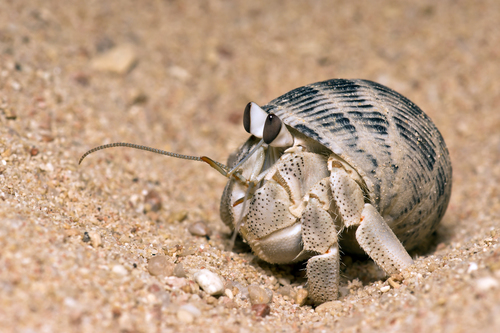
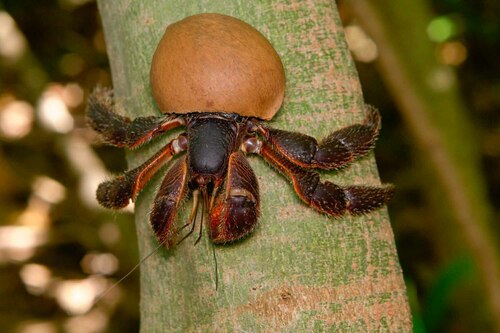
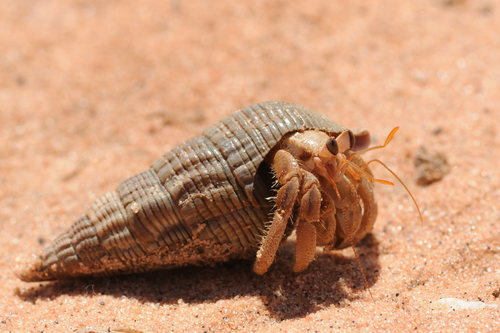
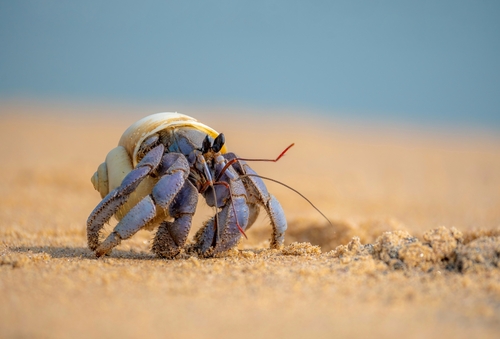
Description: Adult Coenobita perlatus typically reach 80 mm (3.1 in) in length and 80 g (2.8 oz) in weight, and live inside discarded gastropod shells. Their bodies are red or orange, which gives the species its common name: strawberry hermit crab. C. perlatus and other members of the genus Coenobita are not considered easy pets, because the natural conditions they require are difficult and expensive to replicate in captive environments. Even when kept in ideal captive conditions, their lifespan is considerably shortened, and they never reproduce. Distribution: Coenobita perlatus inhabits a broad area of the Indo-Pacific, ranging from Indonesia, Mauritius, Seychelles, and Aldabra in the west to Samoa in the east. Within Australia, the species is only found on Christmas Island, the Cocos Islands, the Great Barrier Reef, and the Coral Sea Islands Territory. In the wild, Coenobita perlatus can live 25 to 30 years, while in captivity they only live 1 to 4 years and do not reproduce. Ecology and behaviour: Coenobita perlatus stores a supply of water in the shell it occupies. It returns to the sea at night to refresh this stored water, and carries out osmoregulation by taking in appropriate amounts of both sea water and fresh water. During the hot daytime, it will bury itself in damp sand to regulate its body temperature and prevent water loss. It can also pull its entire body back into its shell and block the shell aperture with its claws. Coenobita perlatus is an efficient scavenger, and the low population of carrion-breeding flies on many islands has been linked to the presence of this species. It has also been observed using its claws to pinch live flesh from the invasive land snail Achatina fulica. Female Coenobita perlatus brood their eggs inside the shell they inhabit, then release the developed eggs into the sea.