About Coenobita cavipes Stimpson, 1858
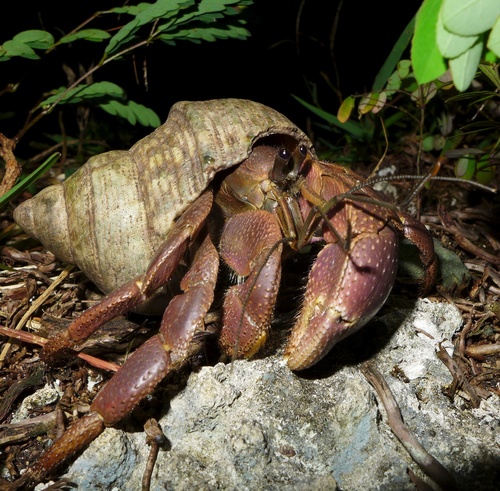
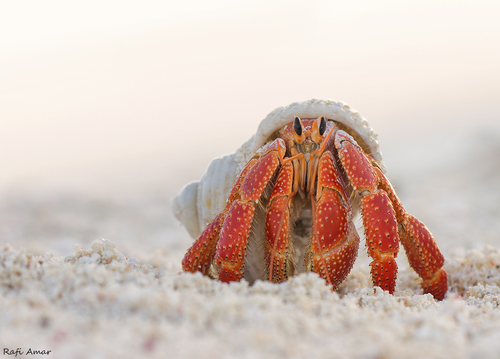
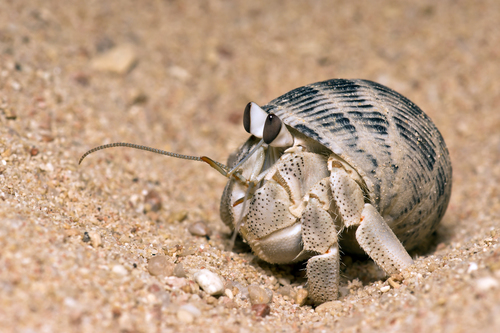
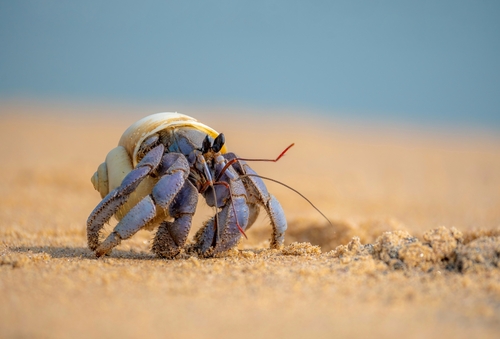
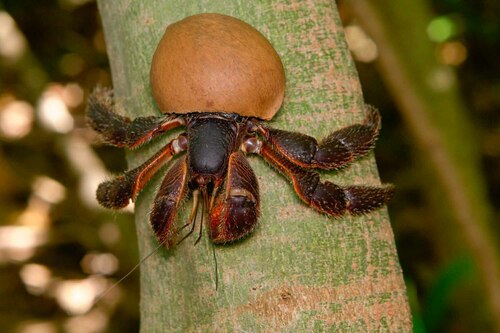
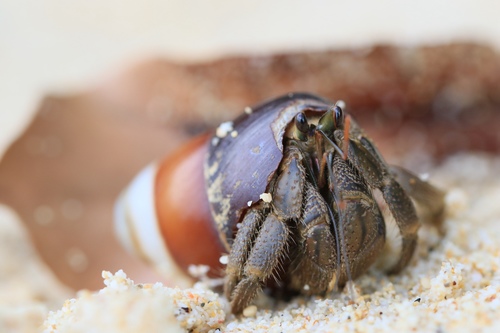
Characteristics: Coenobita cavipes prefer shells from species including Thinoclavis sinesis, Thais svigny, Volema paradiscia, Turbo cornoatus, and Terebralia palustris, and they favor larger shells overall. The large claw of this hermit crab lacks "stitch marks"—small diagonal lines that form along the top of the large claw. Individuals have bodies that are either brown or blue-grey. Their pincers are often a lighter color than their body, and they have long, comma-shaped eyes. Their orange antenna is a common distinguishing feature of the species. The left claw is typically larger, which helps with climbing and movement, while the right claw is usually smaller, an adaptation that assists with collecting food and materials. A purple chela is present, and no laminar teeth occur on the upper part of the outer surface of the left palm.
Habitat and Ecology: This is a nocturnal, terrestrial species of land hermit crab that lives in mangrove trees. It prefers to keep salt water inside its shell; larger hermit crabs of this species have been recorded submerging their entire bodies in seawater. The high salinity of the stored saltwater helps bind the shell to the crab's back. Shell water also supports rehydration, keeps the surfaces of the gills and abdomen wet to aid gas exchange, reduces body temperature, and facilitates osmoregulation. These hermit crabs often live in holes in large groups, and have been observed engaging in cannibalism. Two main explanations have been proposed for this cannibalism: first, the crabs prefer foods they have not eaten recently rather than their usual natural foods, and second, cannibalism may stem from competition for resources. One study found these hermit crabs are most active during October. While the crabs spend their early life stages near the shore, the same study concluded that adult C. cavipes do not prefer to stay close to the shore in later life stages, though they visit water regularly to refill the water stored in their shells. They spend most of daytime in sand or under debris to avoid dehydration. Females release their larvae into the sea.
Reproduction: Females release their larvae into the sea. The typical breeding season falls between mid-May and late August, and many females produce two or more broods per breeding cycle. A study on Okinawa-jima island found that female C. cavipes produce smaller eggs than other Coenobita species, but produce a larger total number of eggs; this trait may be linked to limited availability or poor selection of suitable shells. A separate study on Iriomote Island, Japan found that larval release follows semi-lunar rhythms, but there is no synchronization of larval release with high or low tide, which differs from other Coenobita species. Eggs of C. cavipes are incubated for around 30 days or longer, which is also different from their close relatives. Breeding occurs only once to twice per year.