About Coenobita brevimanus Dana, 1852
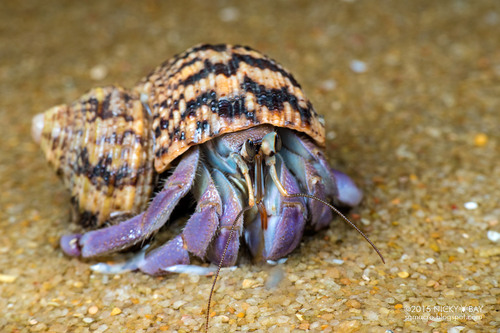
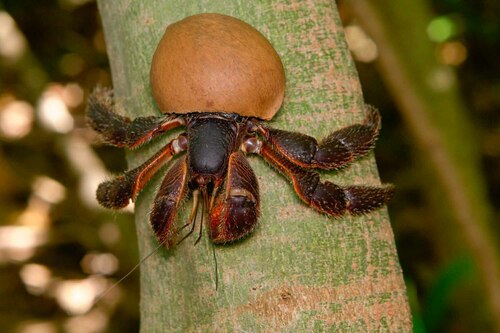
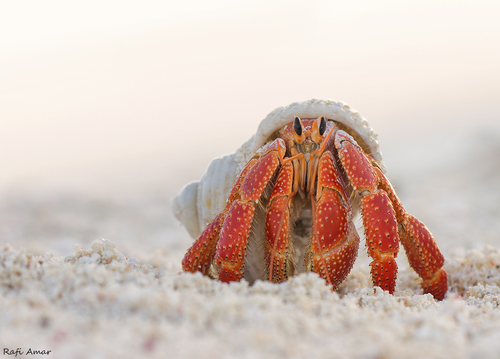
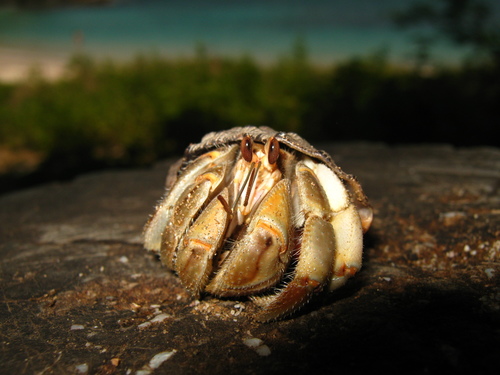
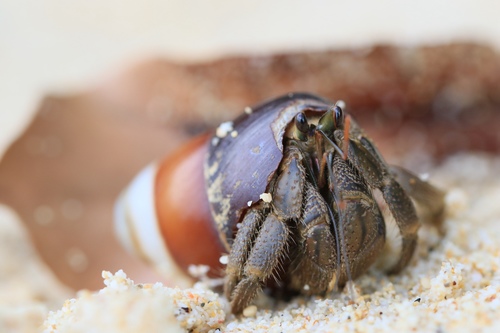
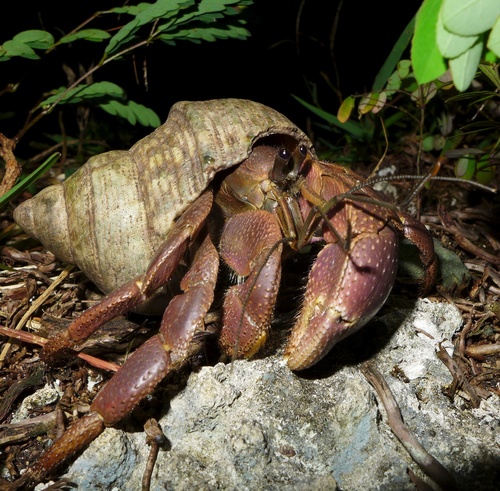
Coenobita brevimanus is one of the larger species in the genus Coenobita. Adult individuals can grow up to 0.5 pounds (230 g), reach the size of a coconut, and have a lifespan between 12 and 70 years. Early in the juvenile stage, this crab has a long area of reddish pigment in the middle of its carapace, as well as matching reddish pigment areas on each side wall of the carapace. By one month of age, these pigment areas develop into a brown stripe running down the middle of the carapace, plus two brown bands on the carapace's side walls. The remaining area of the carapace and the crab's pereiopods slowly transition in color from white to grayish. Once the crab reaches full adulthood, its overall color is brownish red, with violet shading on its limbs; the central brown stripe and side brown bands remain visible in adult crabs. Adult C. brevimanus are darker than most other species in their genus. Adapted for a terrestrial lifestyle, they have an abdominal lung and extremely reduced gills. They can be easily identified by their disproportionately large dark purple pincer and long black eye stalks; a pink color variant of C. brevimanus also exists, where the dominant pincer is pink instead of dark purple. Unlike other species in its genus, C. brevimanus does not prefer large gastropod shells. An armored variant of this species, which has a tougher exoskeleton, specifically favors small shells that only cover the body up to past the third pair of walking legs. While availability and demand for this species have risen in recent years, it is not commonly kept as a pet due to its large size, though it is the largest land hermit crab known to be kept in captivity. Coenobita brevimanus is native to the east coast of Africa and the south-west Pacific Ocean. It has also been reported in East Africa, the Philippines, Japan, China, and Taiwan, with confirmed records indicating a continuous distribution from the east coast of Africa to the south-west Pacific Ocean. This species typically lives inland away from the coastline in moist environments such as rainforests. It does not like getting wet, but still requires very high humidity, generally needing at least 80% humidity and preferring temperatures between 80 and 85 degrees Fahrenheit, which limits its distribution primarily to tropical zones. The larvae of Coenobita brevimanus are brooded inside the female's shell, then laid in seawater. This egg-laying event is the only time an adult C. brevimanus returns to water after reaching adulthood. Larvae develop from the planktonic larval stage to the megalopal stage before migrating from the sea to land. Before migrating, they develop the habit of taking discarded gastropod shells to inhabit. If gastropod shells are not available, often because shells have been collected for the souvenir trade, C. brevimanus will use human litter such as soup cans as alternative shells. After acquiring a shell, the crabs migrate onto land. Once they complete this migration, they are fully terrestrial, and are the most terrestrial species in the genus Coenobita; they are often found over 100 meters from the coast. Once on land, they molt approximately once every 18 months. To molt, they burrow underground, complete the molt, and only emerge once their new exoskeleton hardens, a process that can take up to a full month. C. brevimanus is most highly active during the month of July; activity increases in the months leading up to July, and decreases after July ends. Although terrestrial, C. brevimanus can only tolerate a 28% loss of body water. Loss of more than 28% of body water causes severe disruption to oxygen transport, and the species has difficulty recovering from periods of dehydration. To prevent dehydration, C. brevimanus fills its shell with either brackish or fresh water. This species can detect volatile chemicals in the air that correspond to food and water sources, and orients itself using these chemicals, an ability that helps it locate food and unevenly distributed inland water supplies. C. brevimanus is an omnivorous scavenger that is primarily active at night. When given a choice between fish and fruit, it prefers fish. It is also known to prey on smaller hermit crab species such as C. rugosus, meaning it acts as both a scavenger and a predator.