About Coelotrochus tiaratus (Quoy & Gaimard, 1834)
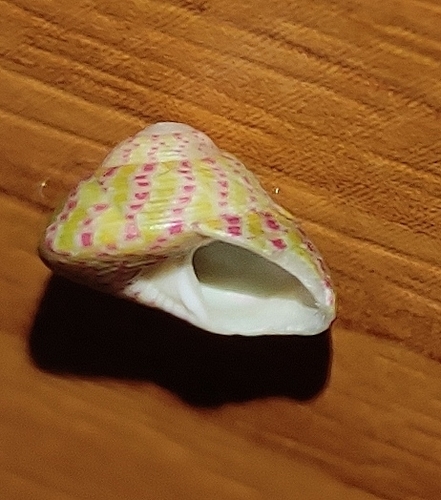
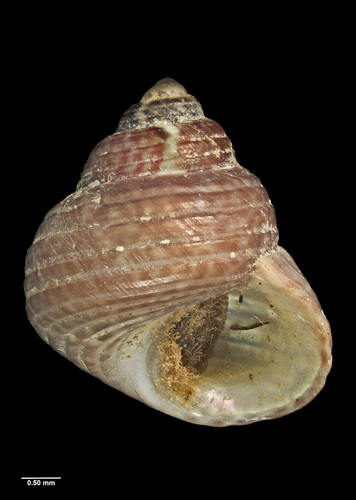
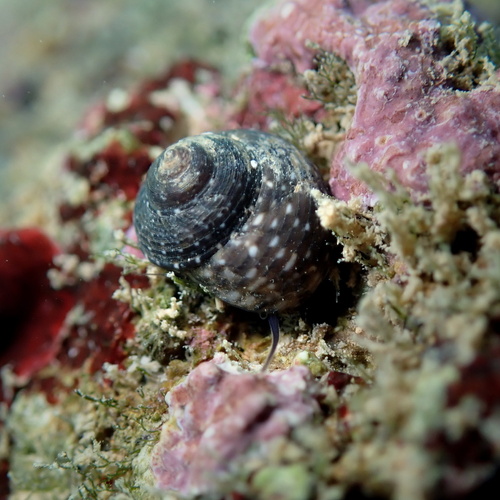
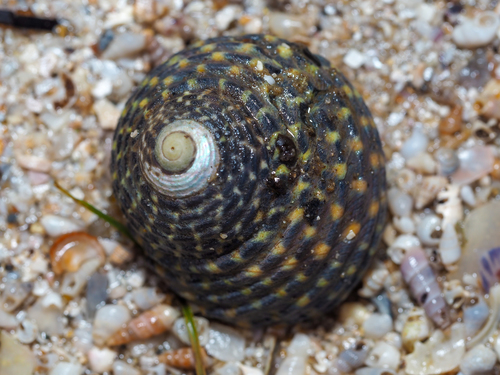
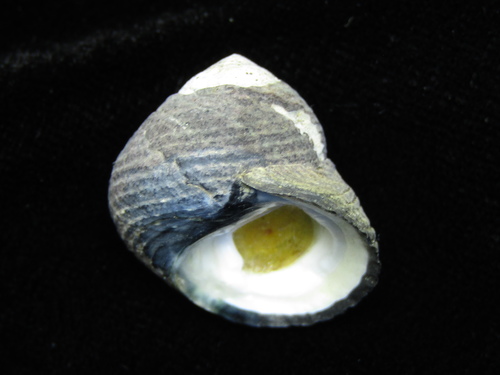
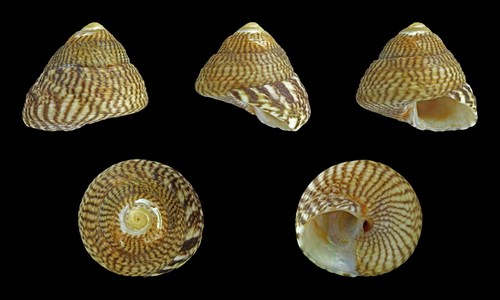
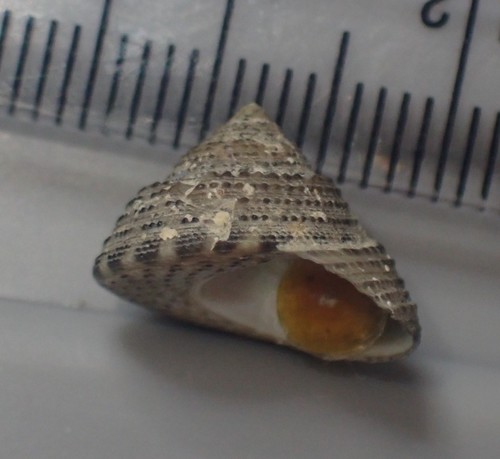
Coelotrochus tiaratus (Quoy & Gaimard, 1834) has a shell that grows to 18 millimeters in length. This depressed conical shell is very deeply false-umbilicate and rather thin. The spire has convex outlines, the apex is acute, and it becomes lemon yellow when eroded. The shell has 5 to 5½ whorls that are nearly flat; the upper margin of each whorl is prominent and projects beyond the periphery of the whorl before it. The body whorl is keeled at its periphery. The sculpture above the periphery consists of 5 to 8 spiral lirae per whorl, which are cut into close, oblique beads. The interstices between these lirae are finely and obliquely striate; one or two of the broader interstices usually have a small central riblet. The shell is whitish or yellowish, and finely tessellated or articulated with reddish brown. The tessellations are formed when narrow radiating stripes break apart, and these stripes are frequently continuous across the base of the shell. The base of the shell is nearly flat, and has seven or eight concentric, close, fine lines. These lines are crenulated in a distinct irregular pattern by clear, short, oblique impressed marks, and the interstices between the lines are finely radiately striate. The subrhomboidal aperture is smooth on the inside. The columella is oblique and nearly straight, with an indistinct, barely noticeable fold near its upper end. It is inserted on the side of the umbilicus, not at its center. The smooth umbilical area is white or yellow. The false-umbilicus is deep and narrow, but is partly filled by a white callus, and does not taper to a point. Specimens from rocky shores are often eroded and encrusted with coralline algae, while specimens found on shell, gravel, or cobble substrata are usually clean. This species is primarily a grazer that feeds on hard surfaces, and it is most abundant within beds of bivalves. It also occurs in tidal channels at the mouths of harbours, where it grazes across empty pipi shells. This marine species occurs off New Zealand and the Chatham Islands, found subtidally down to a depth of 30 meters across a range of habitats.