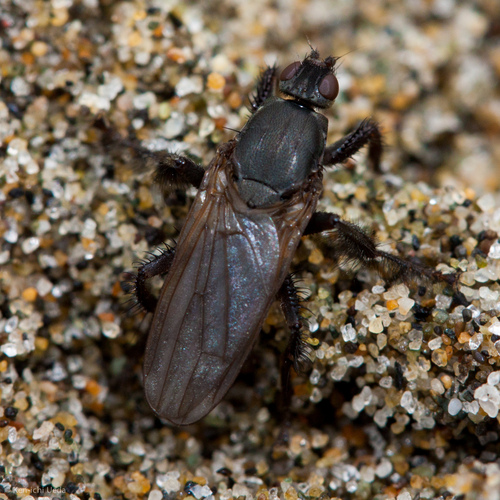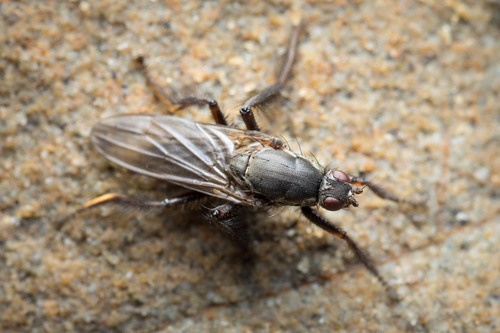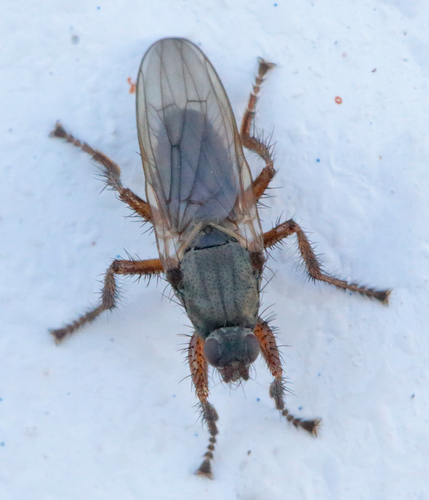
About Coelopa frigida (Fabricius, 1805)
Coelopa frigida (Fabricius, 1805) is the most common species of seaweed fly. These flies typically aggregate on beaches with large amounts of stranded algae, and occasionally swarm inland. Their physical traits include a dark brown to black body, lighter colored legs, and large, translucent wings. Males are generally larger than females, and the species has a wide range of adult body sizes. C. nebularum is currently considered either a close relative of C. frigida or a possible subspecies of C. frigida, so information about C. nebularum is included here. C. frigida has four defining morphological characteristics. First, adult body size ranges from 5 mm to 6 mm, and is determined by alpha or beta alleles linked to chromosomal inversion. The alpha allele produces larger individuals that develop a "peacock's tail", but these larger individuals typically take 2 to 4 additional days to develop before reaching adulthood. Adult body color ranges from dark brown to black. Second is leg color: all C. frigida legs are roughly the same size, with only color varying between individuals, ranging from light brown to yellow to black. Third and fourth are the tergites and their associated bristles. Most C. frigida individuals have 6 tergites, whose size varies based on how far an individual has progressed through adult life, and tergites are generally dark brown in color. The bristles on the tergites have varying lengths, and most are proportional to the overall body size or tergite size. Setae (bristles) are either black or match the color of the tergite they attach to. C. frigida is most commonly found on beaches with a steady supply of stranded kelp, because the species depends on decaying green and brown algae for feeding and breeding. Its well-documented geographic range extends up the North Atlantic Coast into Iceland, and includes the coasts of Russia, the North Sea, and the Faroe Islands. Populations of C. nebularum have been reported on the Pacific Coast of North America, the coast of Japan's Kuril Islands, and the eastern coasts of Russia. C. frigida requires a constant supply of algae to feed and lay eggs, so its preferred habitat is coastal beaches with stranded seaweed. Population density and spread are determined by key factors including the age of stranded algae, the presence or absence of high winds or storms, the rate of algae decay, and temperature. The main food source for C. frigida is seaweed washed up onto beaches. Adult flies detect the scent of seaweed and lay their eggs in decaying algae. The environment of the seaweed allows eggs to hatch, after which larvae burrow into the seaweed. The brown and green algae preferred by C. frigida are most often from the genera Laminaria and Fucus. Research is ongoing to determine whether larvae get their required nutrition from the seaweed itself, from microorganisms living within the seaweed, or from a combination of the two. Algae also provides a safe living habitat and ideal moist environment for eggs, preventing desiccation. Most adults remain in their birth seaweed patch until the patch washes back into the ocean, after which adults fly to find new algae patches to feed, live, and mate on.