About Coeligena wilsoni (Delattre & Bourcier, 1846)
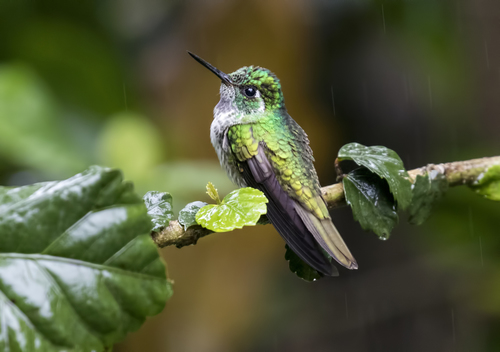
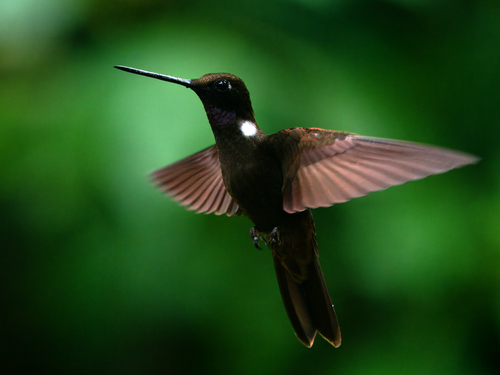
The brown inca, scientifically named Coeligena wilsoni, is approximately 11 to 13 centimeters (4.3 to 5.1 inches) in total length. Males weigh an average of 7.0 grams (0.25 ounces), while females weigh an average of 6.5 grams (0.23 ounces). Both sexes share several key traits: a long, straight, black bill, and a distinct white spot located behind the eye. Adult males have reddish bronze upperparts, a greenish olive lower back, and a bronzy forked tail. Most of their underparts are dull brown, with an amethyst-colored gorget and a white patch on each side of the breast. Adult females are nearly identical to males in appearance, differing only in having a longer bill, a smaller gorget, and a tail that is less deeply forked. Immature brown incas closely resemble adult females. The species occurs along the Pacific slope of the Andes, ranging south from Colombia's Chocó Department through Ecuador to Ecuador's Loja Province. It most frequently inhabits cloudforest edges, but can also be found within the interior of cloudforest. Its elevational range is generally 700 to 1,900 meters (2,300 to 6,200 feet). It is most commonly found below 1,300 meters (4,300 feet), and has been recorded as high as 2,400 meters (7,900 feet).