About Coeligena violifer (Gould, 1846)
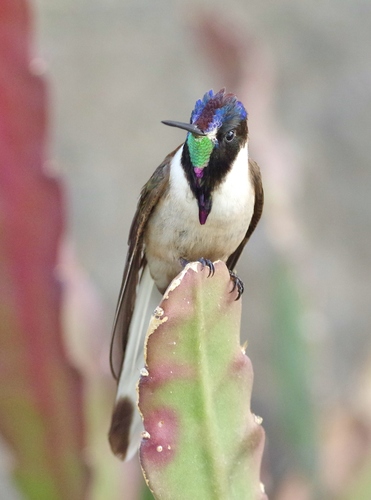
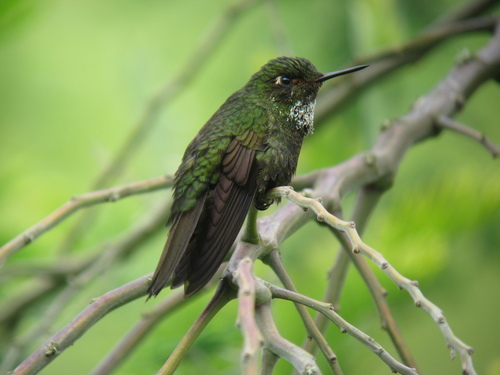
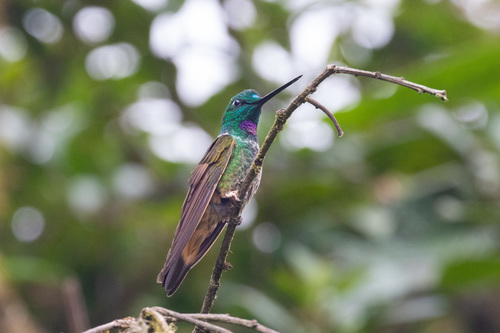
Coeligena violifer, commonly called the violet-throated starfrontlet, has four recognized subspecies. All four subspecies are between 13 and 14.5 cm (5.1 and 5.7 in) long. All individuals have long, straight, black bills, with females having longer bills than males. Both sexes of every subspecies have a white spot behind the eye, and a forked tail that is more deeply forked in males than in females. Weights vary between subspecies and sexes: nominate subspecies males weigh 8 to 13 g (0.28 to 0.46 oz) and females weigh 4 to 6 g (0.14 to 0.21 oz); subspecies C. v. dichroura males weigh 4 to 10 g (0.14 to 0.35 oz) and females weigh approximately 7.9 g (0.28 oz); subspecies C. v. albicaudata as a whole weighs 6 to 12 g (0.21 to 0.42 oz); subspecies C. v. osculans males weigh 5 to 11 g (0.18 to 0.39 oz) and females weigh 5 to 7 g (0.18 to 0.25 oz). Nominate subspecies males have blackish blue heads, shining bronzy green upper backs, orange-buff tails with small bronzy tips. Their throat and upper breast are green with an iridescent violet spot on the throat. A thin gray band separates the upper breast from the green lower breast and cinnamon belly. Nominate females have green heads, buff throats marked with green spots, and darkish green breasts. C. v. dichroura males have an emerald green forehead, a bluish throat patch, a whitish chest band, and a wide bronzy band at the tail tip; females are similar to males but lack the throat patch. C. v. albicaudata males have a bottle green head with an iridescent turquoise forehead and a shiny golden copper back. The outer tail feathers are whitish to pale green at the end, while the inner tail feathers are darker green. Their chin, throat patch, and breast are moss green, and their belly is golden green. Females of this subspecies are similar in appearance to nominate C. v. violifer females, but share the male C. v. albicaudata tail coloration. C. v. osculans males have a greenish turquoise forehead and a dark shining green crown, with a narrow bronzy band at the end of the tail. Their throat spot is variable, and their belly is pale cinnamon. Females are similar to males but do not have the turquoise forehead or throat patch. According to the IOC and Clements taxonomic systems, the subspecies are distributed as follows: C. v. dichroura (the "Huanoco" subspecies) ranges from the Andes of Ecuador's Loja Province south into Peru as far as Junín, Huánuco, and Lima departments. C. v. albicaudata (the "Apurimac" subspecies) is found in the Andean Apurímac River valley in the southern Peruvian departments of Ayacucho, Apurímac, and Cuzco. C. v. osculans (the "Cuzco" subspecies) lives in the Andes of Cuzco and Puno departments in southeastern Peru. The nominate subspecies C. v. violifer (the "Bolivian" subspecies) occurs in the Andes of the La Paz and Cochabamba departments of northwestern Bolivia. Note that the SACC does not recognize any records of this species in Ecuador, and HBW also does not include Ecuador in the range of the "Huanuco" (C. v. dichroura) starfrontlet. The four subspecies occupy slightly different habitats. C. v. dichroura is most often found at cloudforest and elfin forest edges and clearings, and also occurs in secondary forest, at elevations between 1,900 and 3,700 m (6,200 and 12,100 ft). C. v. albicaudata inhabits the understory of elfin forest, between 2,250 and 3,600 m (7,380 and 11,800 ft) in elevation. Like C. v. dichroura, C. v. osculans is usually found at cloudforest and elfin forest edges and clearings, and also occurs in secondary forest, but occupies an elevation range between 2,000 and 3,700 m (6,600 and 12,100 ft). C. v. violifer also occurs at the edges and in clearings of cloudforest and elfin forest, as well as in secondary forest. Its elevation range spans 1,300 to 3,700 m (4,300 to 12,100 ft), and it is most common between 2,800 and 3,300 m (9,200 and 10,800 ft).