About Coeligena torquata (Boissonneau, 1840)
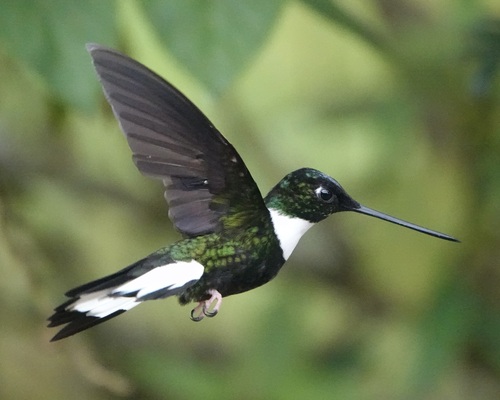
Coeligena torquata measures 10 to 14 centimeters (3.9 to 5.5 inches) in total length. It has a fairly long, straight, black beak that is 3 to 3.5 centimeters (1.2 to 1.4 inches) long. Under most lighting conditions, the nominate subspecies Coeligena torquata torquata appears solid black, except for a very large and distinct white patch on its chest. In ideal lighting, additional physical features become visible: males have a shimmering metallic violet patch on the forehead, and a shimmering green throat. Both sexes have white thighs and fleshy-dusky colored feet. Female throat plumage is dull and marked with some white patches. The black body plumage of the species is mixed with some dark green. The tail of both sexes is black, with white coloring on the basal half of the outermost four tail feathers (rectrices), as well as on part of the tail's underside. Females are overall slightly lighter green than males, and have a slightly smaller white chest patch. This species does not vocalize frequently. Its calls include a quiet, low-pitched, reedy whistle described as "tu-tee," a longer series of repeated notes that sounds like "pip... pip...," and a very quiet spitting sound it makes while foraging. Coeligena torquata lives in humid subtropical and temperate forest regions, including cloud forests, found along both slopes of the Andes from Venezuela to Bolivia. It occurs at elevations between 1,800 meters (5,900 feet) and 3,000 meters (9,800 feet), and is usually found above 2,100 meters (6,900 feet) within Ecuador. It typically forages at heights below half of the forest canopy, and is most often found around thickets near forest edges. It is fairly common across most of its range, and there are no identified threats or conservation concerns for the species.