About Coeligena coeligena (R.Lesson, 1833)
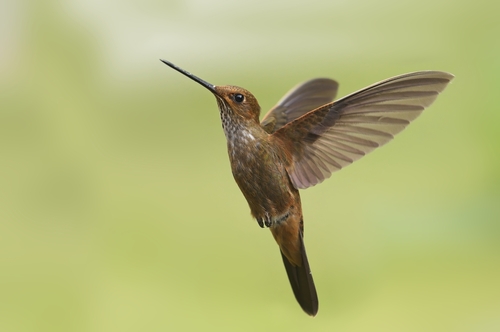
Coeligena coeligena, commonly called the bronzy inca, is approximately 14 cm (5.5 in) long. Males weigh around 7.3 g (0.26 oz) while females weigh around 6.2 g (0.22 oz). Males have a long, straight, black bill that often has some yellow at the base of the mandible; females also have a straight black bill, but it is somewhat longer than the male's. This species is the drabbest member of the genus Coeligena, while many other species in the genus have quite dramatic plumage. Adult males of the nominate subspecies are mostly dark bronzy brown with a maroon sheen on their upperparts, and the lower back is greenish. They have a white spot behind the eye. Their throat and chest have white spots and dusky gray streaks, and the remainder of their underparts are reddish brown. Their tail is forked and colored bronze. Adult females of the nominate subspecies are essentially identical to males in plumage, differing only in bill length and having a less forked tail, and juveniles resemble adult females. Each recognized subspecies differs slightly from the nominate: C. c. zuliana is slightly more greenish and less bronzy than the nominate; C. c. columbiana is smaller than the nominate and has a more olive overall shade; C. c. ferruginea is similar to the nominate, but has less white on the throat and a tawny wash across the underparts; C. c. obscura is the darkest subspecies, with a blackish back and a grayish rather than white throat; C. c. boliviana has dark green spots on the crown and a bronzy blackish purple tail. The subspecies of the bronzy inca have the following distribution: C. c. ferruginea is found in the Central and Western Andes of Colombia; C. c. columbiana is found in the Andes from Lara state in northwestern Venezuela south into the Eastern Andes of Colombia to Huila Department; C. c. coeligena (the nominate) is found in northern Venezuela from Falcón east to Miranda; C. c. zuliana is found in the Serranía del Perijá of northern Colombia and northwestern Venezuela; C. c. obscura is found on the east slope of the Andes from Nariño Department in Colombia south through Ecuador and Peru; C. c. boliviana is found on the east slope of the Andes of central and southeastern Bolivia. The bronzy inca primarily inhabits the edges of humid pre-montane forest, but it also occurs in more open landscapes with scattered trees, and in coffee plantations. It occurs at elevations between 1,500 and 2,600 m (4,900 and 8,500 ft).