About Coelastrea aspera (Verrill, 1866)
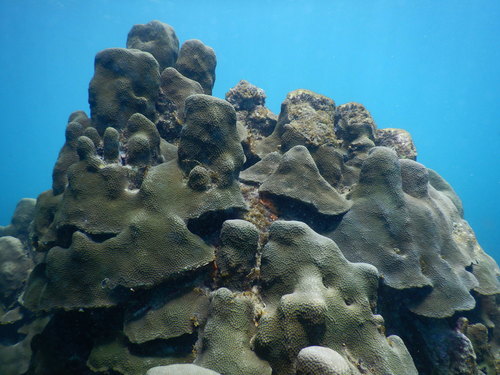
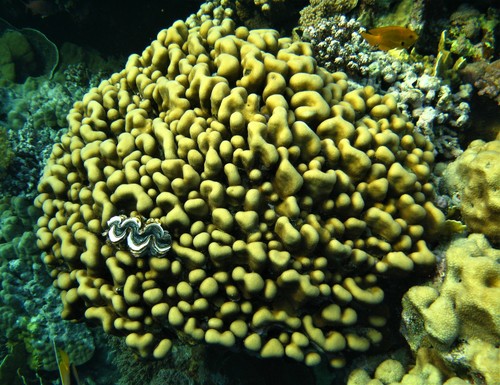
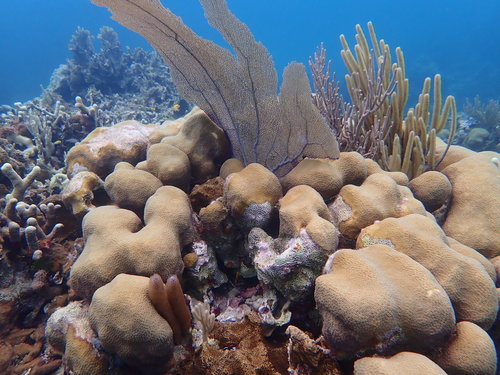
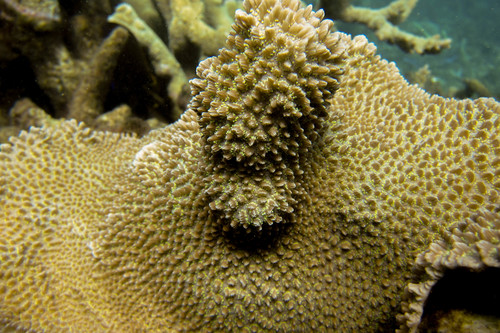
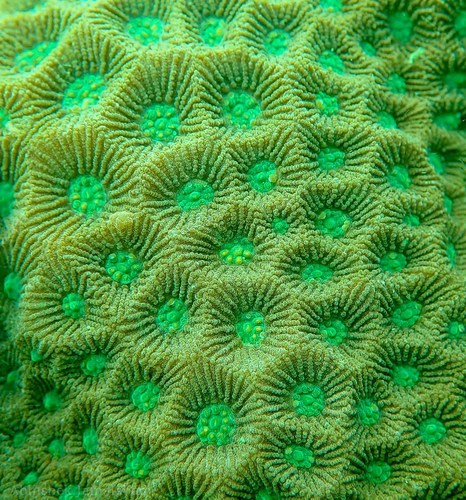
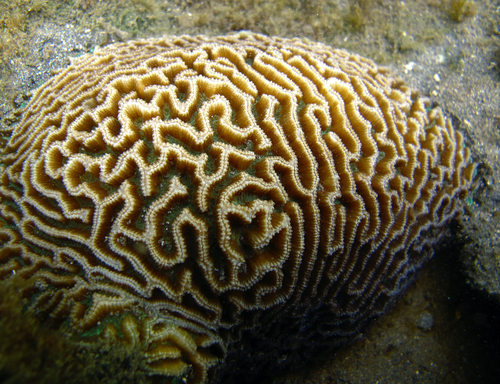
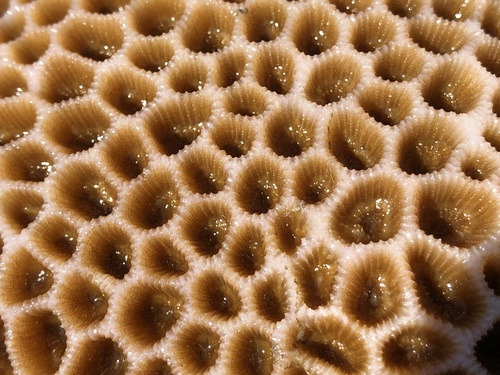
Colonies of Coelastrea aspera are either encrusting or massive. Their surface has a honeycomb-like appearance, because their corallites are arranged in a cerioid pattern, where several polyps share a common wall. The corallites themselves are deep and angular, with thick, straight walls. The septa are even, and larger corallites have alternating long and short septa. Budding is usually intratentacular, meaning it occurs inside the ring of tentacles. Paliform lobes, which are visible through the coral's tissues, are large and broad when colonies grow in protected environments, but much smaller when colonies grow in exposed positions. On intertidal flat rocks, multiple nearby colonies may grow together to form a level expanse several metres across. The general colour of this coral is usually pale brown, and its oral discs are often a contrasting cream colour. Coelastrea aspera is native to the Indo-Pacific region. Its range extends from Madagascar and the Red Sea, through the Indian Ocean to Australia, Indonesia, Japan, the East China Sea, and on to the western and central Pacific Ocean. It grows on reef flats, reef slopes, and in lagoons, at depths down to approximately 15 m (49 ft). Coelastrea aspera is a simultaneous hermaphrodite. It most commonly releases packets of eggs and sperm into the water column; these packets are buoyant and rise to the surface, where they break apart to allow cross-fertilisation between gametes from different colonies. The resulting larvae stay near the water surface for a few days. Less commonly, this coral sometimes broods its eggs and developing larvae inside maternal polyps. Some individual colonies have even been observed using both breeding strategies at the same time in different parts of the same colony. C. aspera is a zooxanthelate coral. Its tissues contain symbiotic unicellular photosynthetic zooxanthellae that supply nutrients and energy to the coral host. In return, the coral provides the zooxanthellae with a protected living environment and a steady supply of carbon dioxide. When exposed to stressful conditions, most commonly high water temperature or excessive solar radiation, the coral expels some or all of its symbionts, a process known as coral bleaching. In 1995, a mass bleaching event caused by high water temperatures occurred on a reef flat in Thailand dominated by C. aspera. Researchers observed that the east side of each coral colony bleached, while the west side remained unaffected. They hypothesised that the corals "remembered" an earlier bleaching event caused by solar radiation, and had developed built-in defences on the previously affected side. In 2000, researchers detached a number of these colonies and rotated them 180°. When another severe bleaching event occurred in 2010, they collected samples to count the number of zooxanthellae present on each side of rotated corals and unrotated control corals. They found that rotated corals had significantly higher zooxanthellae levels (four times as many) in their previously affected areas than unrotated corals. This result confirmed that previously affected areas had developed stress coping strategies, and that this coral retains a bleaching resistance "memory" that lasts at least ten years.