About Codium tomentosum Stackh.
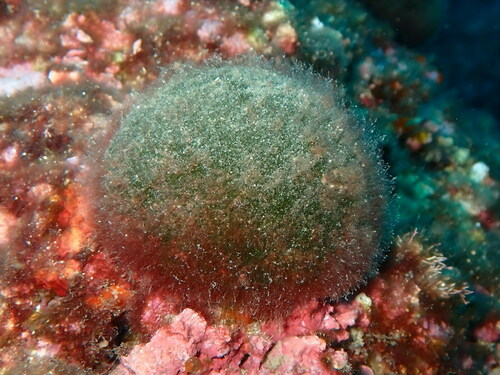
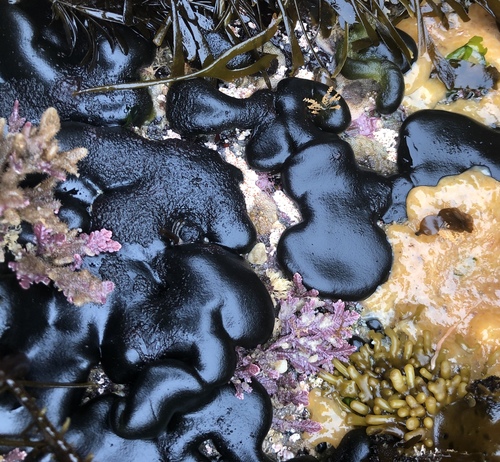
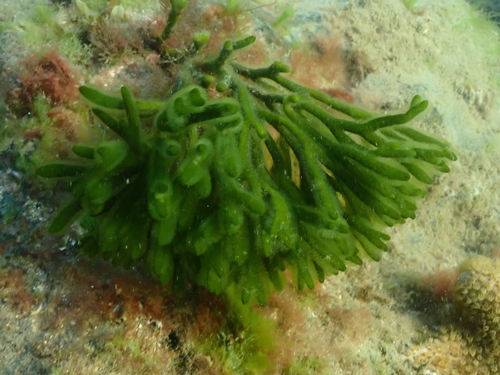
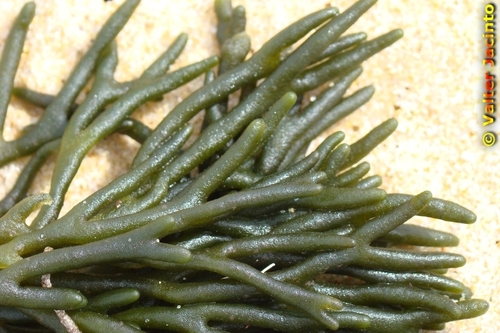
Codrium tomentosum, scientifically named Codium tomentosum Stackh., has a saucer-shaped holdfast made of closely woven strands that gives it a uniform appearance. Its thallus, also called frond, has a dichotomous, heavily branched structure with thin branches that each have a circular cross section. This alga grows up to 30 cm (12 in) in length, has a spongy texture like felt, and is covered with colourless hairs that are visible when it is submerged. Its cortex is made of club-shaped vesicles that form a palisade-like layer. C. tomentosum is native to the northeast Atlantic Ocean, ranging from the British Isles south to the Azores and Cape Verde. It has also been recorded along African coasts and in various other parts of the world, and its type locality is England. It grows on exposed rocks in deep rock pools on the lower shore. In 2003, a study was conducted in Guernsey to examine whether the spreading related taxon Codium fragile subsp. tomentosoides was displacing or eliminating native C. tomentosum from the island. Contrary to expectations, the study found that the native species was still thriving on the lower shore, while C. fragile subsp. tomentosoides was restricted to rock pools in the upper mid-littoral region. A similar 2000 study of exposed shores in western Ireland found that compared to thirty years prior, C. fragile subsp. tomentosoides had decreased in abundance while C. fragile subsp. atlanticum had increased; native C. tomentosum had maintained its population size and had not been displaced. The sap-sucking sea slug Elysia viridis feeds on both C. tomentosum and C. fragile, and has a symbiotic relationship with these algae. When the slug ingests fluids from the algae, the algal chloroplasts remain intact and photosynthetically active inside the slug's digestive diverticula for several days. These chloroplasts continue to synthesize sugars, which the slug then metabolizes. The chloroplasts' photosynthetic activity degenerates over time, so the slug must constantly replace them by consuming more Codium species.