About Codium setchellii N.L.Gardner
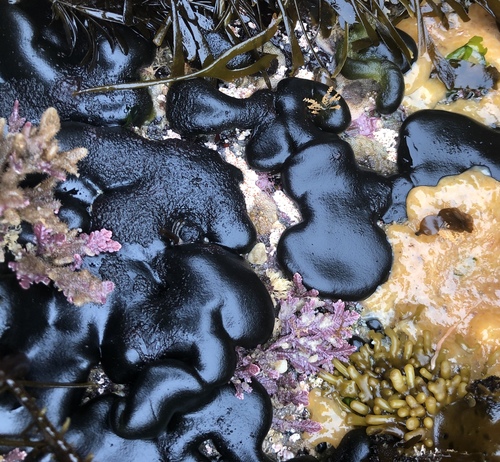
Codium setchellii is a species of seaweed that forms bulbous, gently wrinkled green to greenish-black cushions, 6–15 mm (0.24–0.59 in) thick and up to 25 cm (9.8 in) in diameter. When two individuals meet and grow together, they can exceed 25 cm in diameter. Like all members of the order Bryopsidales, each individual organism is a single large cell containing multiple nuclei. Its surface ranges from glossy to velvet-like in appearance, similar to globs of tar, and its texture matches thick velvet or felt. The smooth surface of its thallus is created by tightly packed filaments. This seaweed grows tightly fused to the rock it inhabits. It closely resembles Codium convolutum, a species only recorded in the Southwest Pacific around New Zealand. It also looks extremely similar to Codium ritteri, which forms coarse spongy cushions and shares overlapping range and habitat with C. setchellii in Alaskan and British Columbian waters. C. setchellii has a smoother appearance than C. ritteri, which has a minutely dotted surface. C. setchellii is native to the East Pacific, where it occurs from Alaska to Baja California. It grows on marine shorelines, in habitats ranging from the mid intertidal to upper subtidal region, and is most commonly found in the low intertidal zone. It adheres to rock faces, and usually grows on vertical rock surfaces. It can withstand exposure to strong wave action and periodic burial in sand, but it cannot tolerate harsh sun or drying conditions, so it prefers moist, shady microhabitats such as crevices, overhangs, and north-facing rock faces. Persistently low levels of coastal fog increase this species' mortality by raising exposure to UV radiation. C. setchellii is not an abundant species: even in suitable habitat, one study found that it covers only 1.8% of available surfaces. Its relative rarity is thought to be linked both to its strict microhabitat requirements and grazing pressure from herbivores. A wide range of grazers feed on C. setchellii: the sea slug Placida dendritica is the main consumer in spring and summer, while the snail Lacuna marmorata is the main consumer in fall and winter. Placida dendritica performs kleptoplasty, sequestering chloroplasts from the seaweed it eats to help camouflage itself while grazing. This sea slug specializes on C. setchellii and similar algal species, and is very efficient at finding new C. setchellii individuals to graze, sometimes forming groups of 70 to 90 sea slugs on a single C. setchellii thallus. A transplantation study of this species found that it can only grow when sand is present nearby. C. setchellii cannot adhere to or grow on sand itself, but transient burial by sand or scouring from sand keeps populations of algal grazers low enough for this slow-growing seaweed to survive, as grazers would otherwise quickly eliminate it. Despite being slow-growing, the encrusting C. setchellii can sometimes overgrow and smother other rock-attached organisms, including other algae and sessile invertebrates. As a cushion-forming macroalgae, many other macroalgal species grow as epiphytes on top of its thallus. These epiphytes include multiple red algae species: Colaconema rhizoideum, Antithamnion densum, Campylaephora gardneri, Erythrotrichia carnea, Griffithsia pacifica, Herposiphonia plumula, Polysiphonia pacifica, Porphyrostromium boryanum, and Pterosiphonia dendroidea. Epiphytes on C. setchellii also include brown algae species: Ectocarpus commensalis, Ectocarpus siliculosus, and Feldmannia simplex. C. setchellii is unusually long-lived for a green alga. If an individual survives its early life and reaches a diameter of 4 cm or more, it will typically live for several years. As with most other Codium species, its life cycle is likely a simple diplontic sexual cycle. Most reproduction occurs in winter, from November to December, when the dominant diploid thallus produces gametangia. This species is dioecious, meaning male and female gametangia develop on separate individuals. Both male and female gametangia release mobile, flagellated gametes into the water. After fertilization occurs in seawater, the resulting zygote eventually settles onto a rocky surface, and a diploid germling grows into a mature adult thallus. Parthenogenesis has never been observed in C. setchellii, though it does occur in the related congener Codium fragile. There is also no evidence that C. setchellii can reproduce asexually through thallus fragmentation. While experimental transplantation of broken fragments is possible, detached thallus pieces cannot re-adhere to rocky surfaces on their own, so they die.