About Codiaeum variegatum (L.) Rumph. ex A.Juss.
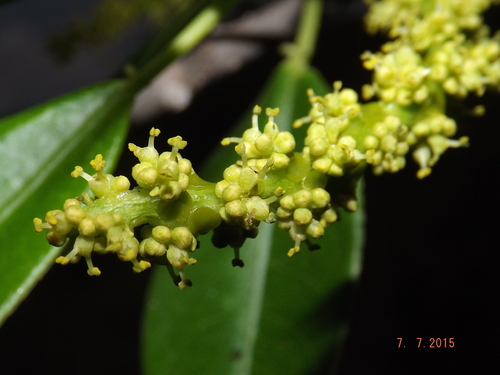
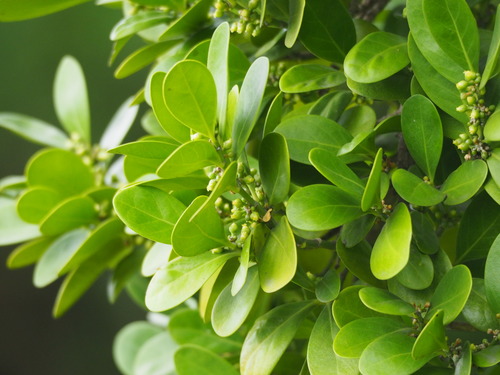
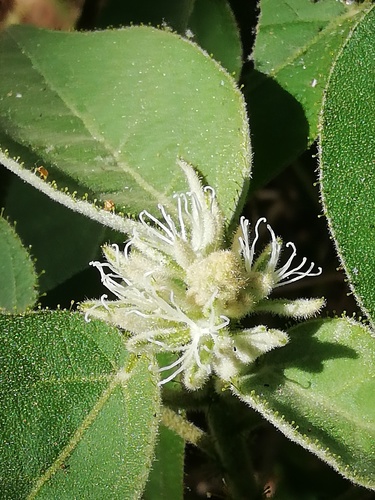
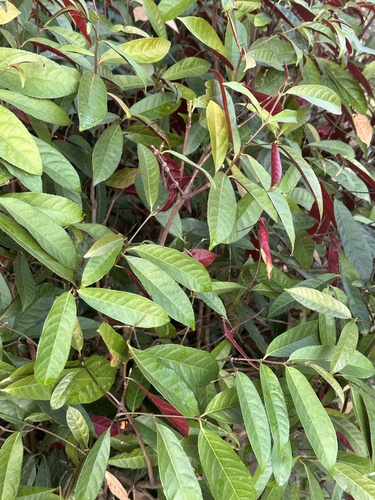
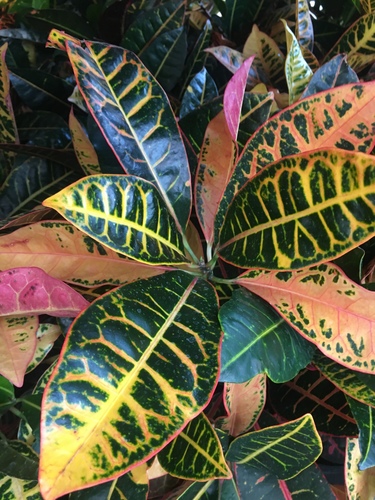
Codiaeum variegatum (L.) Rumph. ex A.Juss. is an evergreen, monoecious tropical shrub that grows up to 3 m (9.8 ft) tall. It has thick, somewhat leathery, shiny leaves arranged alternately along stems. Foliage ranges from 5.0–30 cm (2.0–11.8 in) long and 0.5–8.0 cm (0.20–3.15 in) wide. Mature leaves can take many shapes: diamond, teardrop, violin-like, ruler-lanceolate, lanceolate, oblong, elliptical, obovate, or ovate-spatulate. This species is famous for its vivid leaf coloration, which is especially bright in higher sunlight. Leaves display tie-dye-like patterns of green, yellow, and purple, with hues and intensity that vary by variety. Leaf petioles measure 0.2 to 2.5 cm long. Like other euphorbs, it produces long raceme inflorescences 8–30 cm (3.1–11.8 in) long, with separate male and female flowers. Male flowers are white, with five small petals and 20–30 stamens; their pollen is oval, measuring about 52x32 microns. Female flowers are yellowish and have no petals. It typically blooms in early autumn, though timing varies by location. Its fruit is an inedible, toxic capsule roughly 9 mm (0.35 in) in diameter, containing three 6 mm (0.24 in) diameter seeds, and it is toxic to most mammals. In its natural range, Codiaeum variegatum (commonly called variegated croton) grows in Malesia (including Borneo, Java, the Lesser Sunda Islands, Maluku, the Philippines, and Sulawesi), Papuasia (including the Bismarck Archipelago, New Guinea, and the Solomon Islands), Queensland, and the Pacific islands of Fiji, the Santa Cruz Islands, and Vanuatu. It is now found in many other areas because it is widely cultivated. Like most spurges, all parts of C. variegatum release a milky, caustic sap when broken or cut, which dries to a latex-like consistency. Care should be taken to avoid touching this latex, and the plant should only be handled with sufficient protective gloves and eye protection. For most people, small accidental drops of sap on hands or skin do not cause ill effects if promptly washed off with warm soapy water, which can be followed by hand sanitizer or mildly diluted isopropyl alcohol. However, direct contact between this Euphorbiaceae sap and the eyes, ears, nose, mouth, genitals, or any open wound is strongly discouraged, as it may cause adverse effects. Complications from sap contact range from mild to extreme burning pain, itchiness, rash, or temporary dulling of the senses. Depending on the affected body region, this reaction can cause temporary or long-term issues with sight, hearing, taste, touch, or smell, among other problems. People with sensitive skin may develop contact dermatitis from contact with even small amounts of sap. The entire plant, including bark, roots, inflorescences, and foliage, is poisonous. Its primary active alkaloid is 5-desoxyingenol. The plant also contains an oil that is strongly purgative and is a suspected carcinogen. Consuming its seeds can be fatal to both children and adults. In tropical climates, crotons are grown as attractive hedges and potted patio specimens, valued for their striking foliage. They only survive outdoors in winter where temperatures do not normally drop below 10 to 13 °C (50 to 55 °F); colder temperatures cause leaf loss. In colder climates, they are grown in greenhouses or as houseplants. Cultivated garden crotons are usually smaller than wild plants, rarely growing over 1.8 m (5.9 ft) tall, and come in a wide diversity of leaf shapes and colors. They are sometimes grouped under the name Codiaeum variegatum var. pictum (Lodd.) Müll. Arg., though this taxon is not botanically distinct from the species and is usually treated as a synonym.