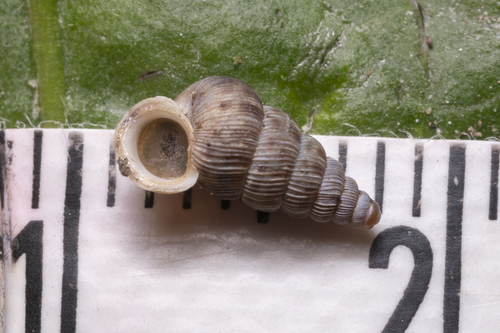
About Cochlostoma septemspirale (Razoumowsky, 1789)
This species, Cochlostoma septemspirale, was first described by Razoumowsky in 1789. The shell of this species is light greyish brown with three rows of reddish brown spots. It has 6 to 8 regular ribs per millimetre and 7 to 10 convex whorls. The inside of the aperture is whitish, and there is no significant sexual dimorphism in the shell. Shell width ranges from 3.2 to 4.4 mm, and shell height ranges from 6.7 to 10.2 mm. The soft-bodied animal is medium-sized, 5 to 6.5 mm long, and greyish with a faint brownish hue. This species is distributed across southern Europe, extending from the Pyrenees to southern Germany and the central Balkans. It is the most widely distributed species within the genus Cochlostoma. C. septemspirale lives in forest habitats, on rocks, rock rubble, walls and grassy slopes, occurring at elevations up to 2100 m. It feeds on disintegrating plant substrate, and sometimes also feeds on the film of algae that grows on limestone. The animal moves slowly, is not very active, and is very shy. However, it will emerge from its shell when placed on a cold object. It is only active during wet weather, and closes its operculum when the soil is dry. During very wet weather conditions, this snail can climb trees up to 2 m high. It hibernates between stones, under leaves and under grasses; activity stops when temperatures drop below 6 to 7 °C. Eggs with a diameter of 1.0 to 1.1 mm (occasionally as small as 0.6 mm) are laid from April to October, mainly between May and June, roughly 1 cm below the surface. The female covers the eggs with faeces and mucus. Eggs are laid in clutches of up to 10 eggs. Juveniles hatch after 45 to 60 days, and reach full adult shell size after approximately one year.

