About Cochliomyia macellaria (Fabricius, 1775)
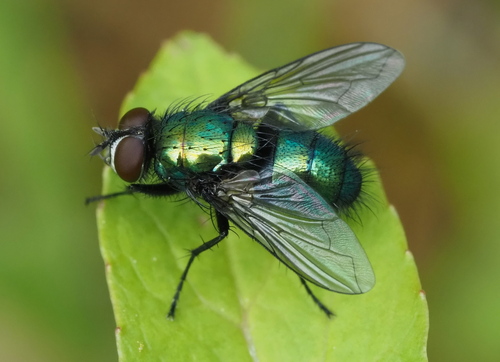
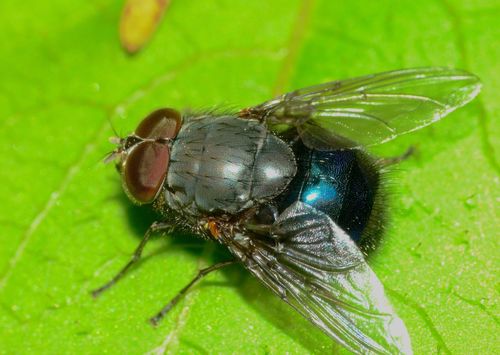
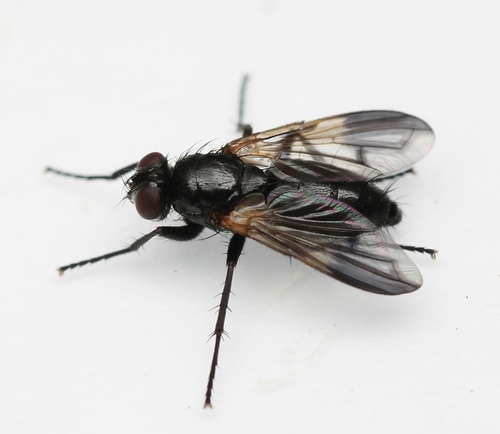
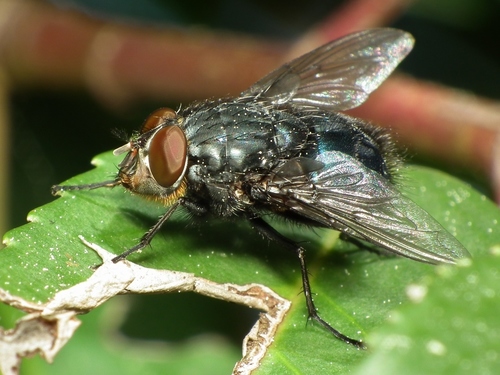
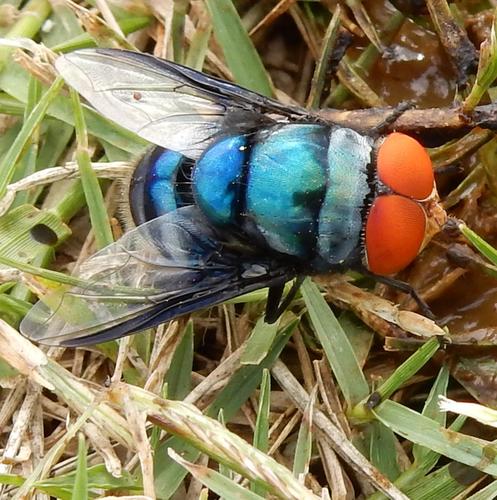
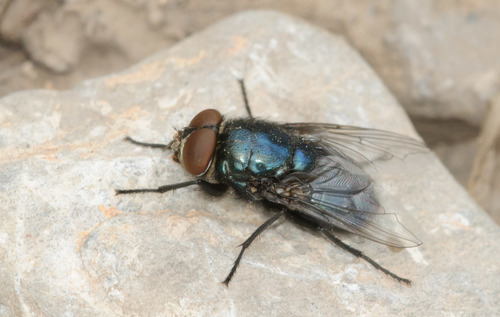
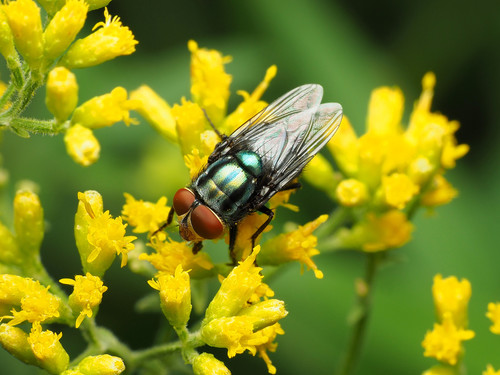
Cochliomyia macellaria is a species of blow fly classified as intermediate in size, with dull or bright metallic blue-green coloration. Three black longitudinal stripes on the thorax interrupt this blue-green base color. The head and eyes of these flies are orange-red. This species also has pale setae on the fronto-orbital plate outside the frontal bristles. The frontal row of bristles extends anteriorly to the base of the first antennal segment, and contains 12–14 bristles total. The fly's legs range from orange brown to dark brown, while the coxae are orange brown to black with a green metallic luster. C. macellaria has a dark reddish brown anterior femur and an orange-red anterior tibia; the anterior tibia also bears four short bristles on its dorsal side. The wings have an orange brown tint towards their base, and the wing veins range from orange brown to dark brown. Costal segments 2 through 6 follow the proportional ratio 78:56:96:30:6:6. The first genital section is black with a metallic green luster, with scattered setae and a distinct marginal row of bristles. The second genital segment is smaller, dark brown to black, and also has scattered setae.
Cochliomyia macellaria is most commonly found in the southeastern United States, including the states of Florida, Louisiana, and Georgia. While this region holds the highest concentration of the species, individuals have been found as far north as Southern Canada and as far south as the Neotropics, with the exception of Chile and Argentina. Though they occur across this wide range, the species thrives best in warm, humid areas including the Southern United States, Caribbean Islands, Central America, and northern South America. Population sizes in these regions typically increase during periods of extended rainfall. The home ranges of these blowflies are relatively small, especially during the mating season, when individuals stay within a couple of meters of one another.
The average lifespan of an adult C. macellaria is 2–6 weeks. During this time, females maximize their production of surviving offspring. Over their lifetime, C. macellaria females can lay up to 1000 or more eggs, which are typically deposited in groups of 40 to 250. Multiple females may lay eggs together, leading to accumulations of thousands of eggs in a single site.
Feeding habits of C. macellaria vary based on developmental stage and gender. During the larval stage, both male and female C. macellaria dig deeper into the necrotic wounds of host animals and feed on dead tissue. This stage is critical because larvae must accumulate enough nutrients to sustain them through the non-feeding pupal stage, which is one reason larvae grow much larger than adult C. macellaria. As adults, the feeding preferences of the species change. Adult females continue to feed on animal tissues, but preferentially consume live tissue and tissue plasma. Adult males no longer consume animal tissue, and instead feed on nearby vegetation and take nutrients from flower nectar.
Cochliomyia macellaria has extensive medical and economic implications. When C. macellaria larvae infest dead or decaying tissues of animals or humans, the infestation often causes myiasis. After infestation begins, dark brown discharge leaks from the affected wound. As the infestation progresses, affected tissue becomes increasingly agitated and inflamed, and is accompanied by unpleasant odors. Clinical diagnosis that identifies the myiasis makes it easier to identify the C. macellaria larvae. Treating these infestations can be time-intensive, and carries increased risk of recurrence. The standard treatment first involves manual removal of the larvae, followed by application of an antibiotic smear.