About Cochlicella acuta (O.F.Müller, 1774)
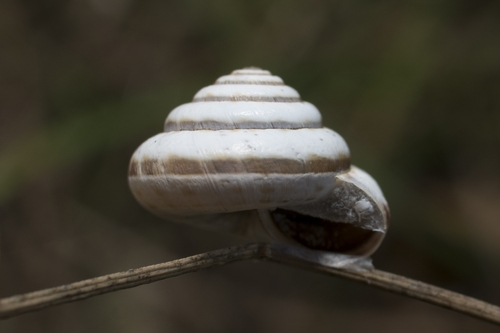
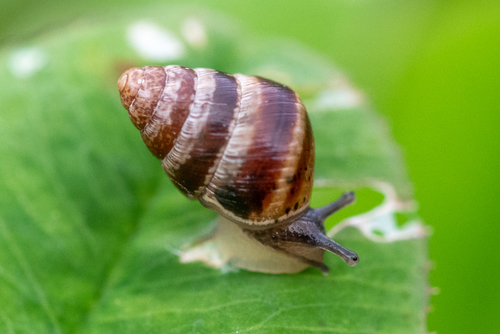
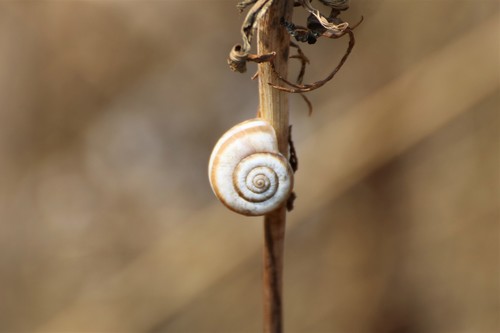
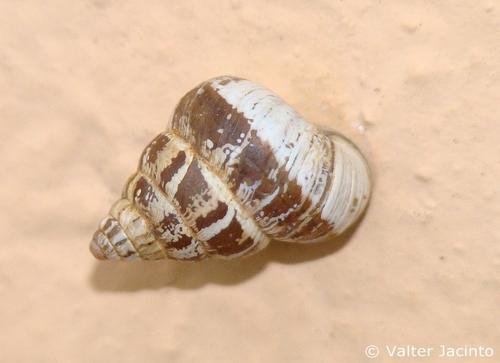
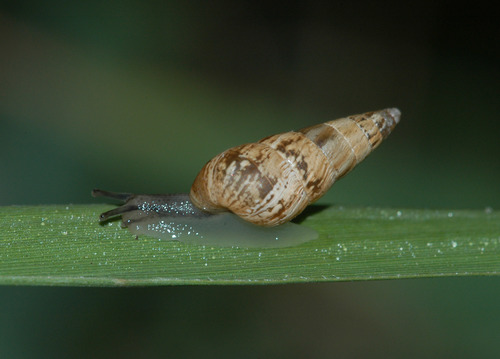
This species, Cochlicella acuta, has an unusually elongated conical shell shape for a helicid. The shell is 10 to 20 mm high, and only 4 to 7 mm wide. Its spire tapers regularly, ending in a blunt tip. The oval aperture has a thin lip, and the narrow umbilicus is almost completely covered. Shell color and markings are highly variable. It often has a cream or off-white background with many pale brown blotches, which are sometimes arranged into spiral bands. Brown streaks frequently run across the shell's whorls. There may sometimes be two spiral bands of dark brown or black; these are often reduced to only one band restricted to the body whorl, and sometimes no bands are present at all. According to Welter-Schultes' description, the 9-15 x 4-7 mm shell has 8-11 whorls, with a sharp edge on juvenile specimens. The shell may be evenly white or marked with brown spots. Compared to the shell of Cochlicella barbara, C. acuta's shell is less brownish, more slender and taller; the upper whorls of C. acuta are also slightly more rounded, and juvenile C. acuta have a much sharper edge at the periphery of the lowest whorl. The soft body of this species is very light yellowish. The dorsum has blackish brown pigment, with one dark medial line on the dorsum, and two dark lines (which correspond to retractor muscles) extending from the sides to the upper tentacles. This species is native to parts of Europe. Its native range covers south-western Europe including Spain, Portugal, and Italy, and western Europe including France, Belgium, the Netherlands, and the British Isles. In the British Isles, it occupies dunes, sandhills, and grassy downs near the sea, found mainly in southern and western England, Wales, islands off the west coast of Scotland, and along the Irish coast. It can be extremely abundant in some locations. It has been introduced to the eastern Mediterranean, including Greece, Israel, and Egypt, and also to Australia, where it has become a problematic invasive pest species. This species thrives on sandy calcareous soils, and often prefers coastal habitats such as sand dunes. During aestivation, it attaches itself to vertical surfaces such as fence posts and tall weeds. Ecologically, Cochlicella acuta acts as an intermediate host for the terrestrial trematode parasite Brachylaima cribbi.