About Cochleoceps orientalis Hutchins, 1991
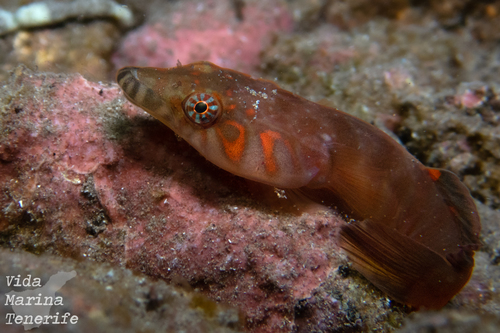
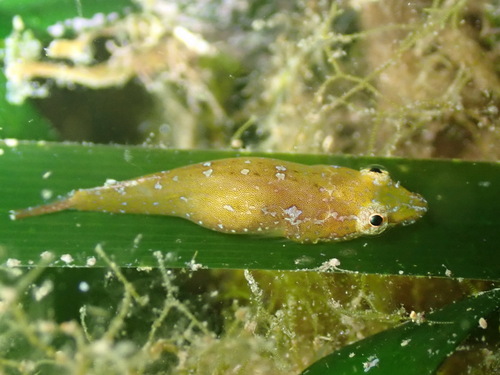
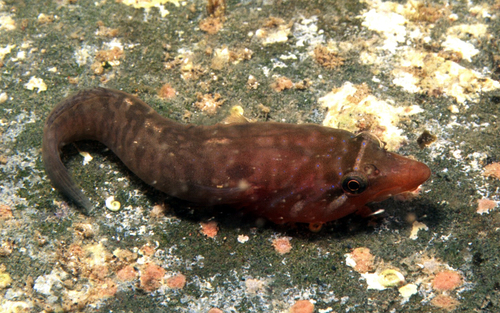
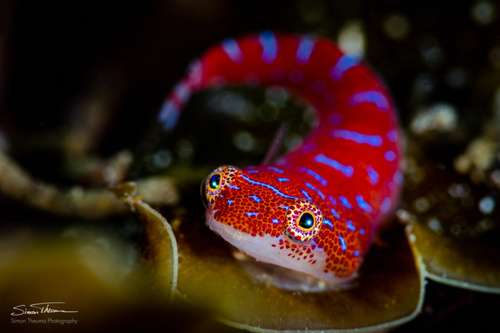
Cochleoceps orientalis reaches an approximate length of 55 mm. It has no scales; instead, its body is covered by a thick protective coating of mucus. Its base colour ranges from bright orange to greenish-yellow. Dark red spots are scattered across its body, and these spots decrease in both size and colour intensity toward the belly. Numerous short, thin, iridescent blue lines appear on its back and sides, and these lines generally run perpendicular to the length of the fish's body. The posterior section of its ventral fins forms a fleshy fringe, while the anterior section of the ventral fins merges into the fish's sucking disc. Sections of this disc have flat dermal papillae, which likely allow the fish to adhere to surfaces. This species is found in the marine waters of southeastern Australia, ranging from Seal Rocks in New South Wales to Mallacoota, Victoria. Cochleoceps orientalis is typically a demersal species that lives at depths between 3 and 40 metres. It is most often found on the kelp Ecklonia radiata, though it may sometimes occur on ascidians and sponges at greater depths. The species avoids open water, where it would be vulnerable to predators, and instead stays attached to kelp via suction, only moving in short dashes when it does travel. Cochleoceps orientalis is known to remove parasites from red morwongs, other types of morwongs, leatherjackets (often called ocean jackets), eastern blue gropers, boxfish, and porcupinefish. For reproduction, adult females deposit eggs on kelp. Both male and female adults stay at the egg site after laying, but only the male guards the eggs.