About Coccyzus melacoryphus Vieillot, 1817
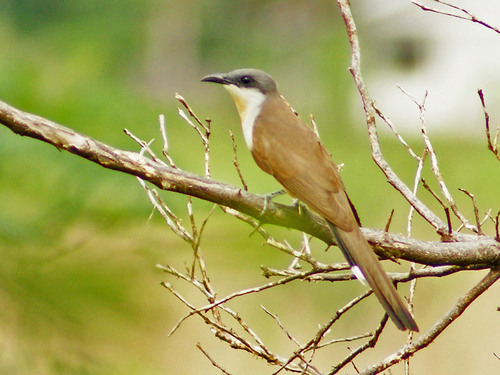
The dark-billed cuckoo (Coccyzus melacoryphus Vieillot, 1817) measures 25 to 28 cm (9.8 to 11.0 in) in total length, with the tail making up roughly half of this length. Males weigh between approximately 42 and 54 g (1.5 to 1.9 oz), while females weigh between approximately 50 and 66 g (1.8 to 2.3 oz). Males and females have identical plumage. Adults have a gray crown and nape, with grayish brown upperparts. Their wings are a darker grayish brown and lack rufous coloring. The upper surface of the tail is brown. On the tail's underside, the central pair of feathers is brown with black tips, the next pair out is blackish with narrow white tips, and the remaining outer feathers are black with wide white tips. The face is gray, marked with a wide black "mask" that extends past the eye. This mask is surrounded by a narrow ring of bare skin that can be citron yellow, olive yellow, or gray. The bird's underparts are pale buff, with the breast slightly darker than the rest of the underparts; the sides of the breast and the flanks are gray. Juveniles resemble adults but have duller overall plumage, a brown crown and nape, gray tips on the tail feathers, and sometimes have rufous coloring in the wings.
In terms of distribution and habitat, the dark-billed cuckoo is regularly found across most of South America, with the exception of Chile, where it only occurs as a vagrant. It is also a resident species on the Galápagos Islands. Beyond Chile, it has been recorded as a vagrant on Clipperton Island, in Panama, Trinidad, the Falkland Islands, Grenada, Florida, and Texas. It occupies a wide range of landscapes, including the interior and edges of tropical deciduous forest, gallery forest, and mature secondary forest, as well as mangroves. It is generally found in lowland areas below 950 m (3,100 ft), but has been documented at elevations as high as 3,600 m (11,800 ft).