About Coccyzus erythropthalmus (A.Wilson, 1811)
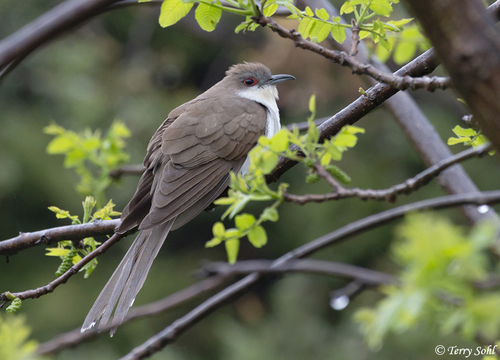
This bird species is formally described as Coccyzus erythropthalmus (A.Wilson, 1811), commonly called the black-billed cuckoo. Adult black-billed cuckoos have a long, graduated brown tail and a black, slightly downcurved bill. Their head and upper body are brown, and their underparts are white. Their feet are zygodactylous. Juvenile black-billed cuckoos are duller in color than adults, and may have some rufous coloring on their wings. Adults have a narrow red orbital ring, while juvenile orbital rings are yellow. Black-billed cuckoo chicks have white, sparsely distributed, sheath-like down that contrasts strongly with their black skin. Chicks also have complex, creamy-colored structures on their mouth and tongue; these structures may look like warts or a parasitic infection, but they are a normal feature of the species. Black-billed cuckoos live in a wide range of habitats. They are most often found along the edges of mature deciduous or mixed forests, and are much less common in coniferous forests. They also occur in younger-growth forests that have abundant shrubs and thickets. Wetlands with large numbers of alder and willow are another common habitat for the species. Finally, they can also live in more open areas including abandoned farmland, golf courses, and residential parks. Regardless of habitat type, black-billed cuckoos are usually well-hidden and tend to remain along habitat edges. Any habitat they use must also have a nearby water source, such as a lake, river, marsh, or pond. On their wintering grounds in South America, they can live in tropical rainforests, deciduous woodlands, semi-open woodlands, and scrub forests. During the breeding season, the black-billed cuckoo is distributed across wooded areas of most of the United States east of the Rocky Mountains. Its breeding range just reaches into North Carolina, Arkansas, Oklahoma, and Tennessee, and the species is not found south of these states during the breeding season. It also occurs in the southern regions of the Canadian provinces of Alberta, Saskatchewan, Manitoba, Ontario, and Quebec, as well as in the maritime provinces of Prince Edward Island, eastern New Brunswick, and western Nova Scotia. During spring and fall migration, black-billed cuckoos can be seen in the southern United States and across all of Central America. In the fall, they migrate to northwestern South America, where they spend the winter. Although it is primarily an eastern North American species, there are confirmed records of black-billed cuckoo sightings in British Columbia, Washington, and California. The species is also a rare vagrant in western Europe and Greenland. Before copulation, the male black-billed cuckoo lands on a branch near the female, holding an insect in its beak. The female then flicks her tail up and down intermittently for roughly 15 minutes, while the male sits motionless. The male then mounts the female, still holding the insect in his mouth, and the pair copulates. After copulation, the male either eats the insect himself or gives it to the female to eat. Females typically lay 2 to 3 blue-green eggs; sometimes clutches of 4 or 5 eggs are produced. The eggs may develop a marbled pattern after a few days of incubation. Adult black-billed cuckoos incubate the eggs for 10 to 13 days. Like other species in the genus Coccyzus, young black-billed cuckoos leave the nest 7 to 9 days after hatching, which is much earlier than most other bird species. Young cuckoos cannot fly immediately after leaving the nest, but they can still move large distances by jumping between tree branches. During this pre-flight period, young cuckoos are more vulnerable to predators than flying adults. To compensate for this vulnerability, juveniles can slowly adopt an erect posture to conceal themselves. They stretch their neck out and point their bill upward, keeping their eyes open and holding still. If a threat moves away, the cuckoo relaxes its posture. Outbreaks of tent caterpillars have a positive impact on black-billed cuckoo populations. During these outbreaks, adult cuckoos begin laying eggs earlier in the season, produce larger clutches, and may even increase their parasitic breeding activities.