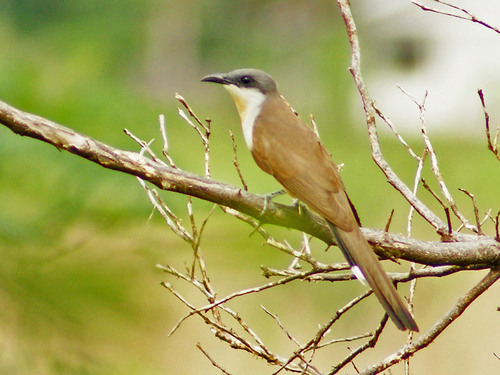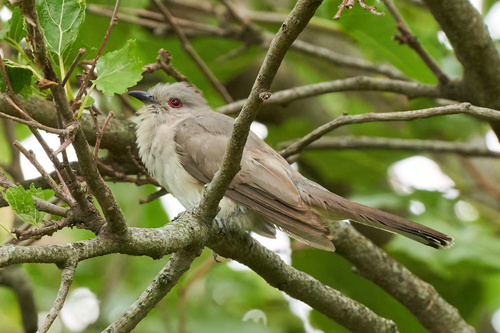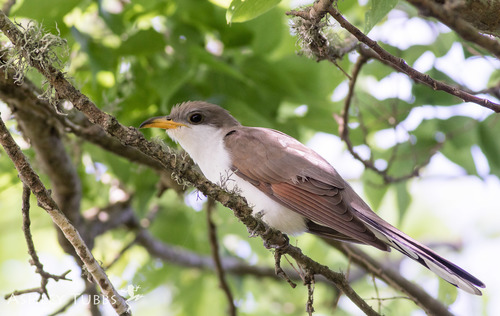
About Coccyzus americanus (Linnaeus, 1758)
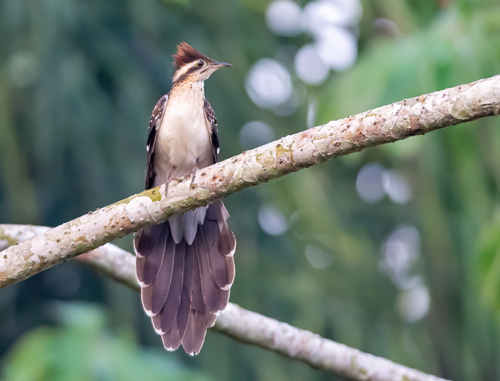
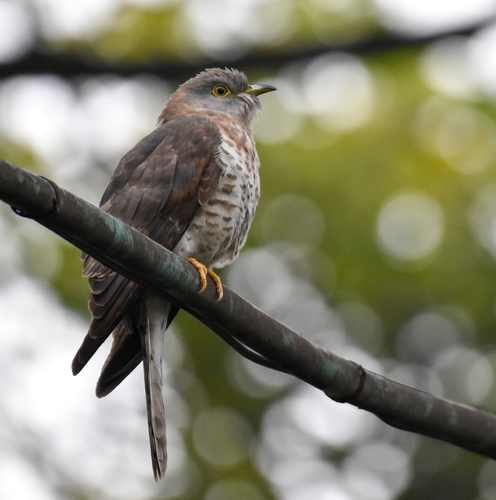
Adult Black-billed Cuckoos (Coccyzus americanus) have a long tail, with brown plumage on the upper body and black-and-white plumage on the underside of the tail. Their bill is curved and black, with distinct yellow coloring particularly on the lower mandible. The head and upper body parts are brown, and the underparts are white. A yellow ring circles the eye, and cinnamon-colored markings are visible on the wings when the bird is in flight. Juveniles resemble adults, but the gray coloring replaces the black found on adult undertails. Adult Black-billed Cuckoos do not display sexual dimorphism, meaning males and females cannot be distinguished by their plumage.
The standard measurements for the species are as follows: length ranges from 10.2–11.8 inches (26–30 cm), weight ranges from 1.9–2.3 ounces (55–65 g), and wingspan ranges from 15.0–16.9 inches (38–43 cm).
Their breeding habitat consists of deciduous woodlands spanning from southern Canada to Mexico and the Caribbean. These birds migrate to Central America, and can travel as far south as northern Argentina. The species is considered a rare vagrant in western Europe.
Black-billed Cuckoos forage for food in dense shrubs and trees, and may also catch insects while in flight. They feed mainly on insects, particularly tent caterpillars and cicadas, but also eat some lizards, the eggs of other bird species, and berries. These cuckoos sometimes gather near areas with insect outbreaks or emergences, including outbreaks of non-native spongy moth caterpillars.