About Coccothraustes coccothraustes (Linnaeus, 1758)
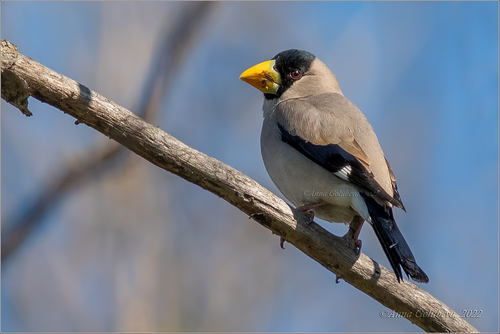
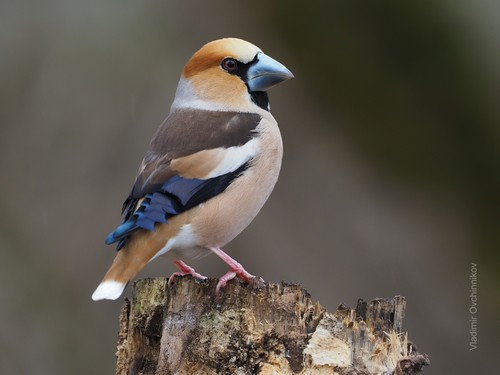
The hawfinch, Coccothraustes coccothraustes (Linnaeus, 1758), has an overall length of 18 cm (7.1 in), a wingspan ranging from 29 to 33 cm (11 to 13 in), and weighs 46–70 g (1.6–2.5 oz); on average, males are slightly heavier than females. It is a robust bird with a thick neck, large round head, and a wide, strong conical beak with a metallic appearance. It has short pale pinkish legs, a short tail, and brown eyes. Female plumage is slightly paler than male plumage. The bird's overall body color is light brown, with an orange hue on the head. A black ring surrounds each eye, extending to and framing the edge of the beak, and the throat is also black. The sides and back of the neck are gray, and the upper surface of the wings is deep black. From the approximate middle of the wing to the edge, there are three distinct stripes: white, brown, and blue. Adult hawfinches molt between July and September. The hawfinch is distributed across almost all of Europe, Eastern Asia (the Palearctic, including northern Japan), and North Africa (Morocco, Tunisia, and Algeria). It has been sighted in Alaska, but this is recorded as an accidental occurrence. It is not found in Iceland, parts of the British Isles, or certain Mediterranean islands. It does occur in southern Europe including Spain and Bulgaria, and in central Europe including parts of England and southern Sweden. The hawfinch's range has expanded further north since the 1950s, and it now occurs as far north as Northern Norway. In Asia, it can be found in the Caucasus, northern Iran, Afghanistan, Turkistan, Siberia, Manchuria, and North Korea. During spring, when breeding, the hawfinch typically lives in deciduous forests, often in fruit-bearing trees such as oaks. It also enters human-managed areas including parks and gardens, and can be found in pine woods as long as a water source is nearby. In autumn and winter, it occupies forests that provide food, especially those with cherry and plum trees. In terms of altitude, the hawfinch occurs at any elevation up to the tree line. The hawfinch is a shy species, making it difficult to observe and study. It spends most of the day in the tops of high branches, particularly during the breeding season. Over its lifetime, it is only seen on the ground when searching for seeds or drinking water, and it always stays near trees when on the ground. While feeding and drinking, it is fairly aggressive and dominant toward both conspecifics and other species, even larger birds. When its chicks hatch, the hawfinch defends a fairly small territory, but when not breeding it is known to defend entire woods. This is interpreted as an evolutionary advantage, as colony rearing is considered safer against nest predators.