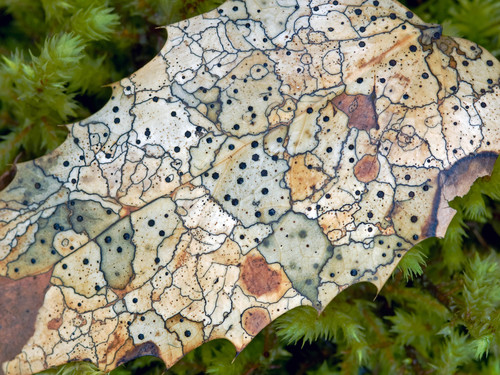
About Coccomyces dentatus (J.C.Schmidt & Kunze) Sacc.
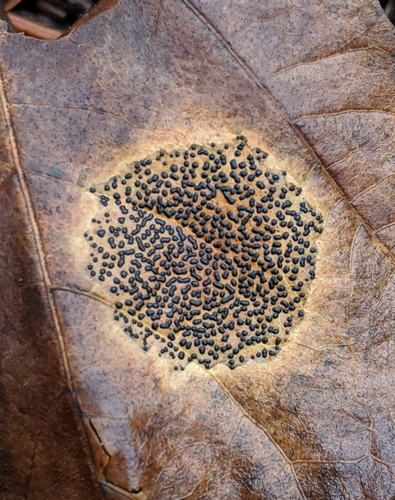
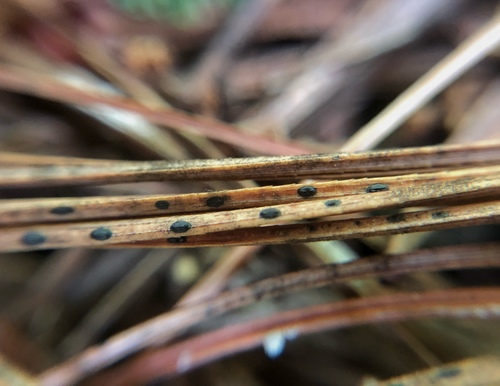
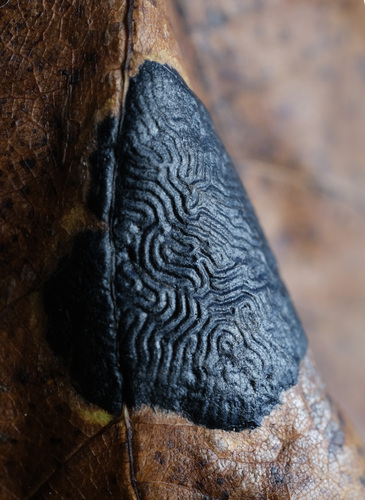
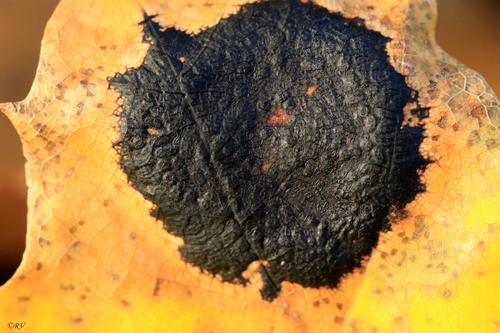
Coccomyces dentatus (J.C.Schmidt & Kunze) Sacc. forms its apothecia within bleached intraepidermal spots on leaves, spots that are bounded by black zone lines. These black lines form from antagonistic interactions between different genotypes colonizing the leaf surface. Apothecia are typically accompanied by asexual fruit bodies called pycnidia, which measure 0.5–1.0 mm in diameter. The apothecia themselves are black and shiny, with four to six sides. They feature a star-shaped pattern of grooves made of lighter-colored cells, and when spores reach maturity, the apothecia open (dehisce) via triangular "teeth" to expose the dull yellow spore-bearing hymenium. The layer covering apothecia is about 30 μm thick, made of carbonized blackened cells 5–6 μm in diameter. A 5 μm thick layer of carbonized supportive tissue sits at the base of the apothecium. The sterile filamentous hyphal cells called paraphyses are unbranched, filiform (threadlike), gradually widen to 2.0 μm at the tip, and contain granular contents. The thin-walled spore-bearing cells called asci are cylindrical to club-shaped, attached to a short stalk, and measure 70–105 by 8–10 μm; each ascus holds eight ascospores. Ascospores measure 45–65 by 3.0 μm, have a thin but distinct outer sheath, and lack septa (cross-walls). Pycnidia develop before apothecia mature. They are intraepidermal, lenticular (double-convex lens shaped) in cross-section, 0.1–0.3 mm in diameter, and covered by a dark brown layer of cells. Phialides are arranged in a basal layer, growing on short conidiophores; they are slender, subulate (tapering to a point), lack a collarette, and measure 5–10 by 2–2.5 μm. Conidia are colorless, rod-shaped, lack septa, and measure 4–5 by 1.0 μm. The putative anamorph form of C. dentatus has been described as Tricladiopsis flagelliformis. When grown on 2% malt agar under standard conditions, this form produces colonies with black centers that grow 7 cm per week. The conidia it forms are thin, curved, and whip-shaped. They have 13–20 septa, measure 65–135 by 2–3.5 μm, and usually bear a single branch typically about 45 μm long, which develops before cells are released. Only a few species in the order Rhytismatales are known to have anamorphs that do not function as spermatia (non-motile male gamete cells). C. dentatus is one of only two species confirmed to have both a spermatial and a non-spermatial state; the other species is Ascodichaena rugosa. Coccomyces dentatus is a saprobic species that grows on the dead leaves of a wide range of angiosperms. It is found very often on plants in the heather family (Ericaceae) and the beech family (Fagaceae), including red, white, and live oak, chestnut, and Castanea sativa collected from Chile. Other common substrate leaves come from trees and shrubs in the genera Rhododendron, Lithocarpus, Berberis, Arbutus, Gaultheria, and Myrica. The fungus is widely distributed, common, and occurs mostly in warm temperate regions. It has been recorded in Tunisia (Africa), Europe, and the Americas. In the northern part of its range, it grows during summer and autumn, while it can be found year-round in subtropical areas. Due to its broad geographic distribution, abundance, and conspicuous appearance, Coccomyces dentatus is the most frequently collected species in the genus Coccomyces.