About Coccoloba uvifera (L.) L.
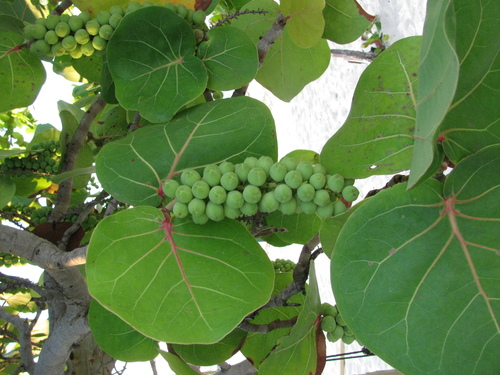
Coccoloba uvifera (L.) L. has grayish bark marked with light patches. Its leaves are generally round, and often start out brownish before maturing to green, and they typically have red veins. Leaves decompose slowly, and turn red before they wither. It produces whitish to greenish flowers arranged on long spikes. In late summer, it bears green fruit around 2 cm (3⁄4 in) in diameter, growing in large, grape-like clusters. The fruit ripens to purplish-red and contains a hard pit that makes up most of the fruit's volume. This species is dioecious, meaning male and female flowers grow on separate individual plants. Fruit development requires cross-pollination, which is carried out by insects including honey bees. Male and female plants can be told apart by the appearance of their flowers, as male plants usually have dead flower stalks. C. uvifera can be propagated from both seeds and cuttings, but stored seeds do not survive. This species is native to Florida, Mexico, Central America, western South America, and the Caribbean (including the Greater and Lesser Antilles), the Bahamas, and Bermuda, where it grows on coastal beaches. While it can survive temperatures as low as approximately 2 °C (35.6 °F), it cannot survive frost. It is wind-resistant, highly tolerant of salt, and moderately tolerant of sun, shade, and drought. It is hardy in USDA zones 9B–11. It is largely unaffected by diseases and pests. The sea grape borer, a moth native to Florida, bores into small twigs and branches, killing the twigs, branches, and their leaves, but it usually does little overall harm to the plant. Coccoloba uvifera is a popular ornamental plant in yards in south Florida. It acts as a dune stabilizer and provides protective habitat for small animals. Tall sea grape plants growing behind beaches help prevent sea turtles from being distracted by lights from nearby buildings. The plant's sap has been used for dyeing and tanning leather. Its wood has occasionally been used for furniture, as firewood, or to make charcoal. The fruits can be eaten raw, cooked into jellies and jams, or fermented into sea grape wine. Its leaves can be used to make tea, and honey bees can produce a distinct type of honey from the nectar of its flowers. In parts of the species' native range, various parts of the plant are used for medicinal purposes. For example, in Puerto Rico and the Caribbean, the plant's roots and bark are used in traditional medicine. In the Yucatán peninsula, tea made from the plant's bark mixed with alcohol is used to treat ulcers. In French Guiana, a juice made from the whole plant called Jamaica kino is used to treat diarrhea and dysentery.