About Coccinia sessilifolia (Sond.) Cogn.
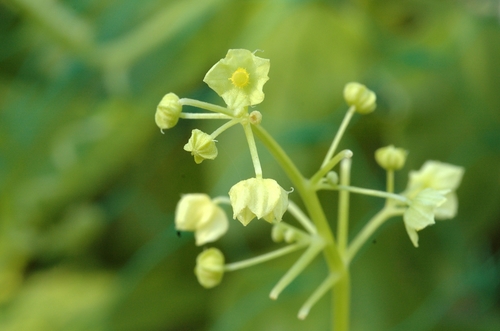
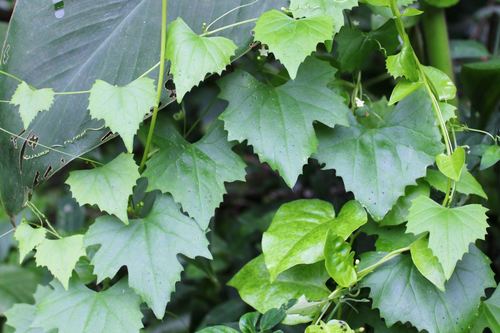
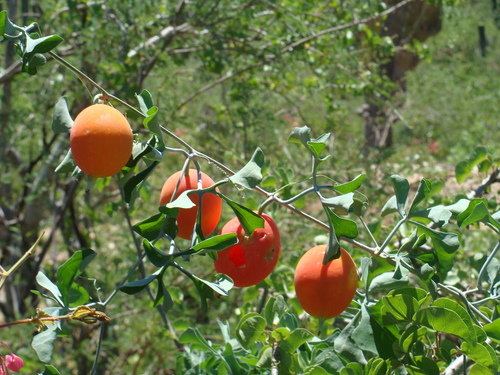
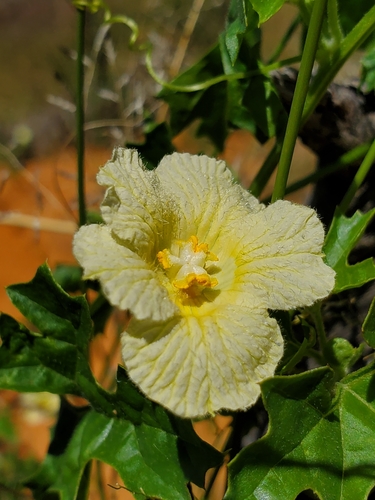
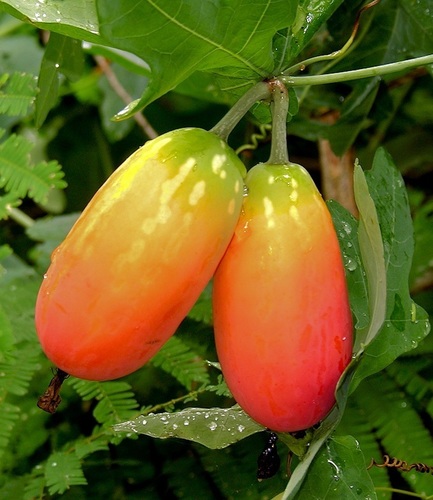
Coccinia sessilifolia (Sond.) Cogn. is a perennial, dioecious climbing plant. Individuals grow a woody hypocotyl tuber and produce herbaceous shoots that can reach up to 5 m in length. Shoots are glabrous and covered in a waxy bluish green layer. Leaves are alternate and most often sessile; short petioles are only found on the first leaves of new shoots, and very rarely on mature shoots. The leaf blade measures 1.5–12.5 × 2.2–13.5 cm, is usually deeply 5-lobed, and is more or less amplexicaulous. The upper surface of the leaf blade is glabrous and marked with clear to whitish pustules. The lower leaf surface is paler than the upper surface, glabrous, and often has small dark glands along its main veins. Tendrils are simple, and very rarely develop into an unequal bifid form. Probracts are up to 1.7 mm long when present, but are usually absent. Flowers of both sexes are most often solitary; male flowers may sometimes occur in small few-flowered racemes. The receptacle is pale green and glabrous. Calyx teeth are 1.5–3.5 mm long, shaped lanceolate to (narrow) triangular, and held erect or reflexed. The corolla is 1.5–3 cm long, colored whitish cream to pale yellow, and very rarely dull orange-brown, with prominent green venation; corolla lobes measure 0.9–2 cm. Male plants have 3 stamens, which are reduced to staminodia in female plants. Anthers of male flowers are sinuate and arranged in a globose head. The ovary is cylindrical and glabrous. A style is absent in male flowers; in female flowers the style is columnar and greenish yellow. Stigmas are bulging and greenish yellow. Fruits measure 8–12 × 3–4 cm, and are shaped ellipsoid to oblong. Immature fruits are green with white longitudinal spots or stripes, and carry a waxy bloom; ripe fruits are red. Seeds measure 6–8 × 3–3.5 × 1–1.5 mm, are more or less symmetrically obovate, and have a flat face. Both male and female plants have 24 equally sized chromosomes (2n=24). This species occurs in South Africa (Gauteng, Free State, Limpopo, Mpumalanga, North West, and western Northern Cape), Namibia (Erongo, Khomas, Oshana, Otjozondjupa), and Botswana (Central District, Kgatleng, North-West District, South-East District). It grows in semi-arid open habitats, excluding the Cape region and high mountains. Its flowering occurs in January to May, and October to December.