About Coccinella septempunctata Linnaeus, 1758
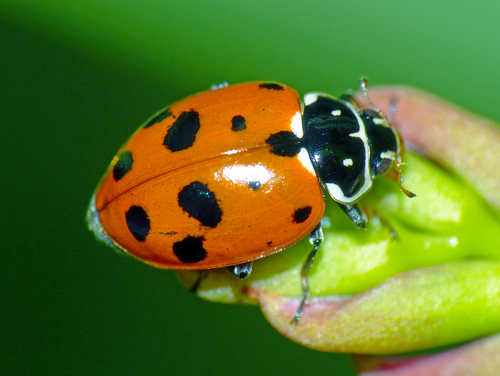
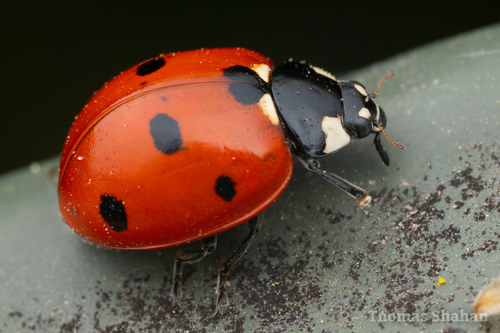
Adults of Coccinella septempunctata (seven-spot ladybird) have an oval, convex body shape. They measure 6.5–7.8 mm (0.26–0.31 in) in body length, around 4 mm (0.16 in) in width, and have orange-red forewings (called elytra) marked with seven black spots. One black spot sits next to the scutellum, where the two elytra meet, and two white patches are located on the elytra just in front of this spot. The remaining six black spots are split evenly between the two elytra, with three per elytron. The size and position of these six spots can vary between individual beetles, and spot fusions and entirely dark melanic forms are rare. The species also has two white spots on the front of the pronotum, one on each side of the inner edge of the eyes. The abdomen underside, pronotum, and legs are all black. Male seven-spot ladybirds have fine hair on their last abdominal segment. Eggs of C. septempunctata are 1 mm (0.04 in) long, spindle-shaped, and coloured orange or yellow.
Coccinella septempunctata was first formally described and named in 1758 by Swedish biologist Carl Linnaeus, in the tenth edition of his work Systema Naturae. It has a broad ecological niche, and lives in temperate climate regions with abundant vegetation and concentrated aphid populations, its main food source. The species originated across much of the Palearctic realm, and is currently found across all of Europe (including the British Isles and European Russia), most of Asia (including the Middle East, China, Japan, the Koreas, India and Pakistan), and North Africa. It has also been introduced to additional regions, including North America (the United States and Canada) and South Africa. In some areas, particularly Europe, populations of C. septempunctata are declining due to the spread of the invasive harlequin (Asian) ladybird Harmonia axyridis. This invasive species is more disease-resistant than C. septempunctata, outcompetes native ladybirds for resources, and even preys on native seven-spot ladybirds. In the United Kingdom, the Asian ladybeetle first reached the south coast of England in 2004; it had previously been introduced to the Netherlands, Belgium and France as a biological pest control agent, but began to multiply uncontrollably. The UK Ladybird Survey, which monitors the spread of the harlequin ladybird across England, has reported that the invader could potentially eliminate indigenous seven-spot ladybird populations.
Seven-spot ladybirds occupy a wide range of habitats, most commonly areas with large aphid populations. These habitats include forests, grasslands, agricultural fields, marshes, and suburban parks and gardens. Host plants include herbaceous plants, agricultural crops, and many types of trees and shrubs. Individuals have been recorded at elevations from sea level up to 1,500 m (4,900 ft). Adult C. septempunctata are active in spring and summer, and enter dormancy during colder months. They overwinter (hibernate) in any available sheltered site, but generally prefer elevated locations such as hilltops. Common overwintering sites include under tree bark and boulders, within hedgerows, dense clumped grass, and leaf litter in parks, gardens, and along forest edges. Adults emerge from their overwintering shelters as air temperatures rise, and emergence timing varies based on how well protected each hibernation site is from weather conditions. The conservation status of C. septempunctata has not been evaluated, so it does not appear on the IUCN Red List or in any CITES databases. It is widespread across its native range of Europe and Asia, and is classified as an invasive species in regions where it has been introduced.
Coccinella septempunctata has a four-stage life cycle, progressing from egg to four larval instars, to pupa, to adult. The full cycle from egg to mature adult takes approximately six weeks. This species can produce up to five generations per year. The breeding season starts in late spring, and reproduction occurs via copulation. Ladybirds begin breeding once they reach sexual maturity, which happens 10 to 14 days after they emerge as adults. Courtship is initiated by males, but immature females and females that are ready to lay eggs will resist male advances. Females have been recorded releasing volatile sex pheromones (a behaviour called 'calling') to attract males; this behaviour was previously undescribed in this widespread species. Recently mated females are less likely to call than unmated females, and the presence of other ladybirds does not appear to affect calling frequency. Breeding in seven-spot ladybirds is polygynandrous: when females mate with multiple males, this increases the female's fecundity, the viability of her eggs, and the proportion of successful offspring.
In summer, fertilized female C. septempunctata lay eggs in clusters of 10 to 30, on leaves, stems, and other vegetation. Females use olfactory signals to avoid laying eggs in areas that already have C. septempunctata eggs. This species often produces more eggs than the local environment can support, which increases offspring mortality, but this reproductive strategy is beneficial when aphid populations are high. On average, females lay between 250 and 500 eggs over their lifetime. Larvae hatch from eggs after approximately four days, though hatching time depends on ambient temperature. The species goes through four progressively larger larval instars, and the duration of each instar is influenced by temperature and aphid availability. After hatching, larvae first eat their own eggshell, then any unfertilized eggs near their hatching site. When the fourth instar is ready to pupate, it stops feeding for one day and attaches its abdomen to a solid surface. The pupal stage lasts around eight days, after which the adult emerges with soft, unpigmented elytra. The black markings on the elytra develop from melanins, while the lighter red-orange colour comes from carotenes. C. septempunctata provides no parental care for its offspring. Males only contribute to reproduction by fertilizing females, while females only produce eggs and deposit them on safe substrates with enough food for hatching larvae. Adult lifespan is approximately one to two years, and depends on whether the individual survives the winter.
Coccinella septempunctata is motile and capable of flight. It is active during the day and dormant at night. During hibernation, adult seven-spot ladybirds gather in large clusters to retain warmth and protection, and to ensure they have access to potential mates immediately after exiting diapause for breeding. When preparing for hibernation, C. septempunctata releases a pheromone to attract other ladybirds to the overwintering site; this specific chemical cue has been identified as 2-isopropyl-3-methoxy-pyrazine. The species also uses chemical cues to locate its prey. It is attracted to both the warning pheromones that aphids release to alert other aphids of predators, and the specific chemicals that plants release when they are infested with aphids.