About Cnidium monnieri (L.) Cusson
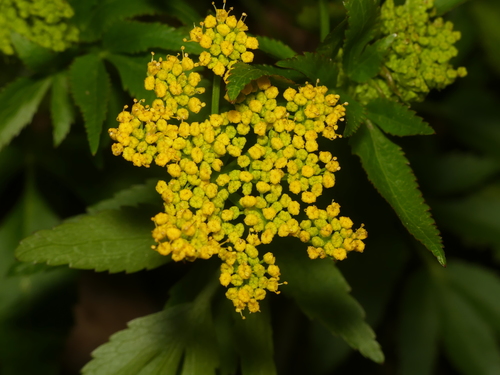
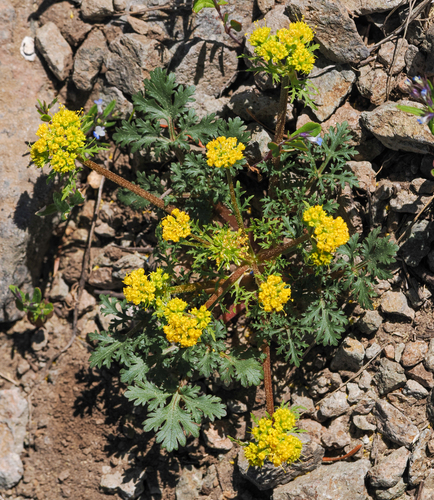
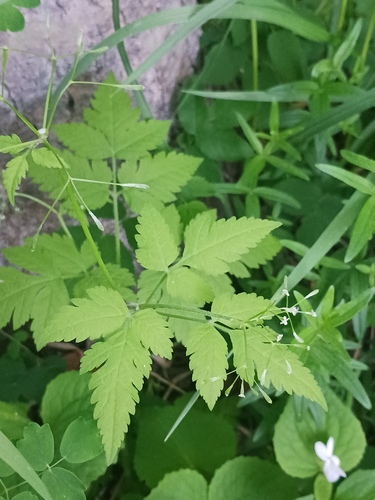
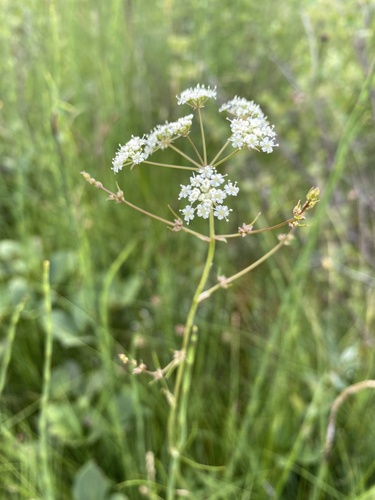
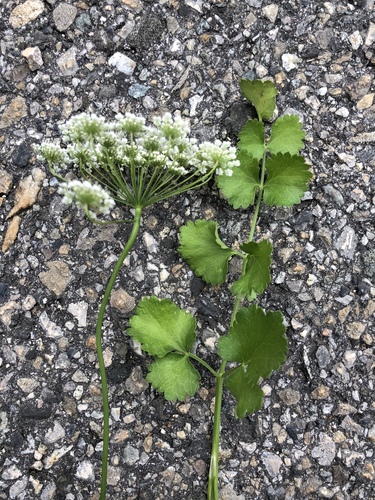
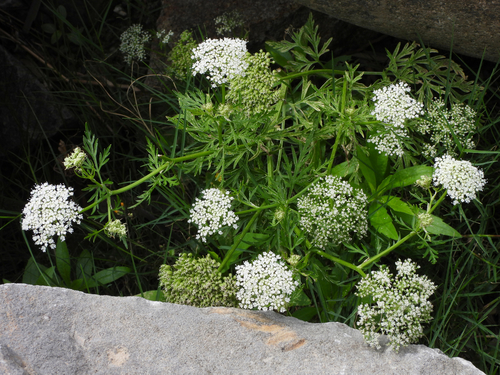
Cnidium monnieri (L.) Cusson is an annual plant. Individuals grow 10–60(–80) cm tall, with a taproot 2–3 mm thick. Stems are solitary, striate, and scabrous. Lower leaf petioles measure 3–8 cm long; the leaf blade is ovate-lanceolate, 3–8 cm by 2–5 cm, and 2–3-pinnate. The ultimate leaf segments are linear to linear-lanceolate, 3–10 mm by 1–1.5 mm, with scabrous veins and margins. Umbels are 2–3(–5) cm across. There are 6–10 persistent bracts, which are linear to linear-lanceolate, 2–3 mm long, with narrowly white membranous, very finely ciliate margins. Rays number 8–20(–30), measure 5–20 mm, and are unequal in length. Bracteoles number 5–9, are linear, nearly the same length as the pedicels, and have ciliate margins. Each umbellule holds 15–20 flowers, and pedicels are 3–5 mm long. Calyx teeth are either obsolete or minute. The stylopodium is conic, and styles are 3–4 times longer than the stylopodium. Fruits are ovoid, 1.5–3 mm by 1–2 mm, with lateral ribs slightly broader than the dorsal ribs. The seed face is flat. This species flowers from April to July, and bears fruit from July to October. This species is native to India, China, Korea, Laos, Mongolia, Vietnam, European Russia (Belarus, Ukraine, Moldova, Crimea) and Europe. It grows in riparian grasslands, and is adventive in Oregon, North America. Cnidium monnieri is one of the most widely used traditional herbal medicines; its fruits have been used to treat a variety of diseases in China, Vietnam, and Japan. To date, 350 compounds have been isolated and identified from this species, with coumarins as the main active constituent. In vitro and in vivo studies indicate that osthole and other coumarin compounds from Cnidium monnieri have a wide range of pharmacological properties effective for treating female genital disorders, male impotence, frigidity, and skin-related diseases. These compounds also show strong antipruritic, anti-allergic, antidermatophytic, antibacterial, antifungal, and anti-osteoporotic effects. While coumarins are confirmed as the main active constituents responsible for the observed pharmacological effects, the molecular mechanisms of their action remain unknown. As a pro-erectile herb in traditional Chinese medicine, Cnidium monnieri and its main bioactive compound osthole appear to act via similar mechanisms to Viagra in penile tissue and the hippocampus; the effects of Cnidium monnieri on testosterone and cognition are still unexplored. Cnidii Fructus (the fruit of this species) has also been used to treat lumbar pain. The fruit has known anti-inflammatory and analgesic properties that help alleviate lower back discomfort. Traditional preparations often combine Cnidii Fructus with other herbs to enhance its therapeutic effects, and bioactive compounds in Cnidii Fructus such as osthol contribute to its pain-relieving capabilities.