About Cnestis polyphylla Lam.
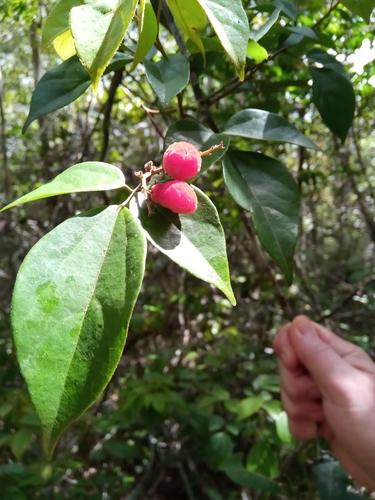
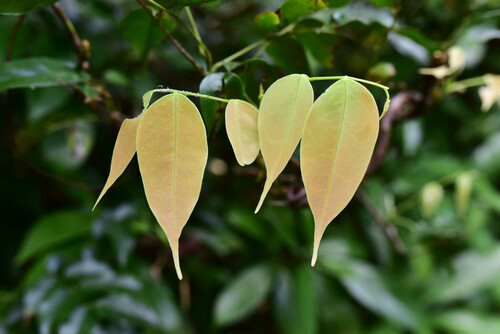
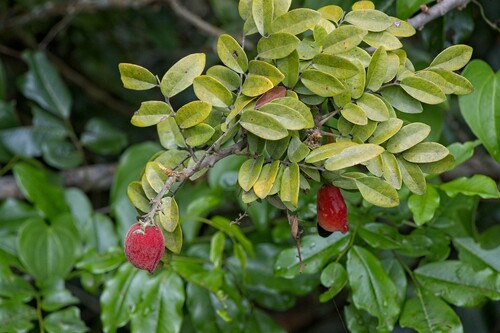
Cnestis polyphylla, commonly known as itch pod, is a liane or scrambling shrub in the Connaraceae family. Its natural distribution stretches south from Kenya in East Tropical Africa, passing through Mozambique and Zimbabwe to Southern Africa. In Southern Africa, it grows in coastal and escarpment forests of Limpopo, Mpumalanga, Eswatini and KwaZulu-Natal, and extends further south to the Eastern Cape. It can also be found growing on the Indian Ocean islands of Madagascar, Mauritius and Réunion. The Cnestis genus holds at least 13 species, many of which remain taxonomically unresolved. Genus members are distributed mainly across tropical Africa and its nearby islands, and their range extends to Southeast Asia and China. Immature leaves of Cnestis polyphylla are red; they shift through bronze, pale green, and mid-green to become bluish-green when fully mature. The leaves are alternate and imparipinnate, with oblong opposite leaflets. Leaflets have an oblique base and blunt apex, measure 2.5 to 3 cm long, and are thinly pubescent on their lower surface. Small yellow flowers are clustered densely in small panicles, and the flower sepals are covered in soft pubescence. The plant produces an almond-shaped capsule that bears a hornlike process at its tip. When mature, the capsule dehisces via a longitudinal split, exposing large, shiny, blackish-brown seeds with a yellowish aril at their base. Both the inner and outer surfaces of the capsules are covered in rigid reddish-brown hairs that easily penetrate human skin and cause intense itching. All parts of this plant are rich in glabrin, a potent neurotoxin that causes convulsions in most animals. This toxic property has led to its use as a fish poison. Leaf extracts of the plant are used to treat skin diseases. The protein methionine sulfoximine is common throughout the Connaraceae family, and other toxic compounds in Cnestis polyphylla have not yet been identified. The roots of some Connarus species are known to contain the glycosides rapanone, embelin and bergenin.