About Cneoridium dumosum (Nutt.) Hook.fil.
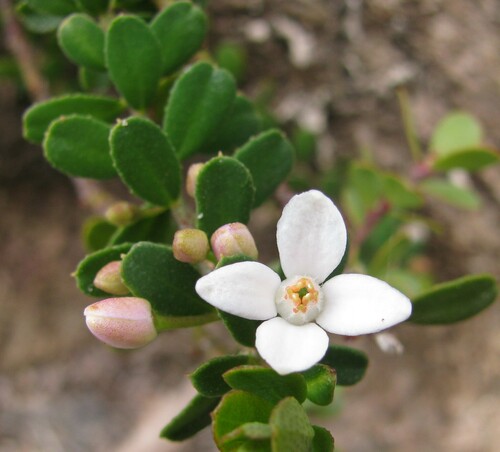
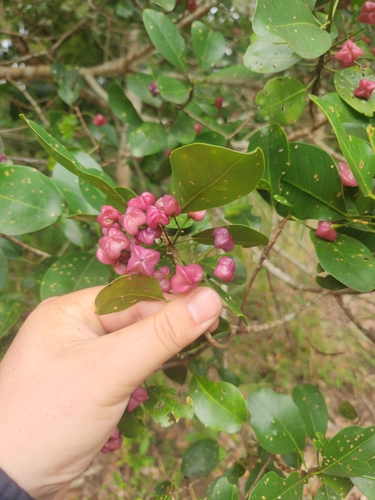
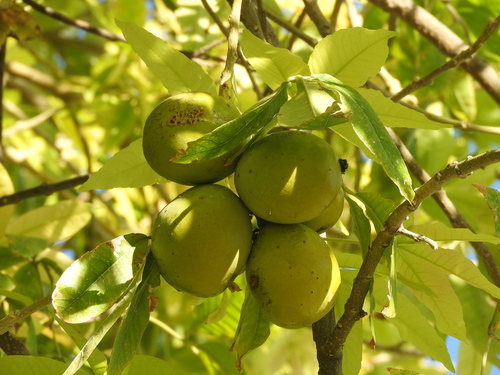
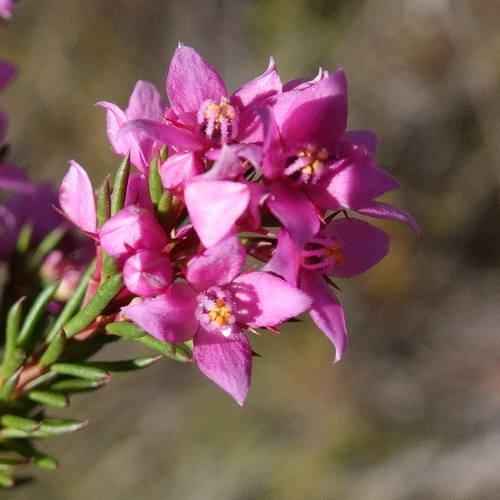
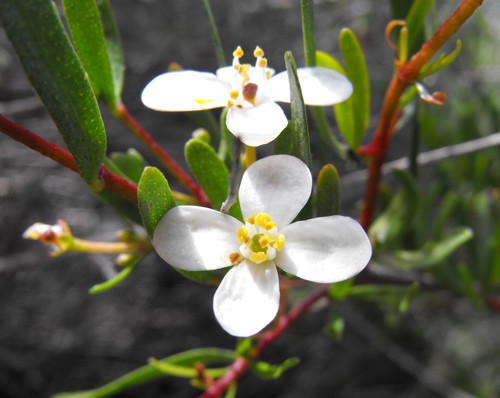
Cneoridium dumosum (Nutt.) Hook.fil. is an evergreen, intricately branched rounded shrub that can grow over 1.5 meters tall and spread just as wide. Its twigs hold small, opposite leaves that are linear to oblong, 1 to 2.5 cm long, hairless, marked with small glands, and aromatic. The inflorescence is a cyme or cluster holding 1 to 3 flowers. Each flower is just over 1 cm wide, with four (rarely five) rounded white petals and eight stamens that have yellow anthers and white filaments. The flowers have a fragrance described as a wonderful citrusy sweet perfume. The plant produces clustered round green berries, around half a centimeter wide, covered in a thin gland-pitted peel like that of a common citrus fruit. As the berries age, they turn reddish to brown, and each berry holds one or two spherical seeds. This species is found in California (United States) and Baja California (Mexico). In California, it grows on the southern coast in San Diego and Orange counties, and on San Clemente Island. In Baja California, it occurs throughout the northwestern part of the state south to the central desert, and also has a disjunct population in the Sierra de San Borja near Bahia de Los Angeles in southern Baja California. It grows primarily on bluffs, mesas, hillsides, washes near the coast, and slightly inland foothills of the Peninsular Ranges, within chaparral, coastal sage scrub, and coastal succulent scrub habitats below 1000 meters. It is considered to play an important role in the habitat of the San Quintin Quail (Callipepla californica subsp. plumbea). This species was introduced into cultivation by Theodore Payne. It is a small woody shrub that has a reputation for being difficult to establish, but with proper care it becomes a long-lived, slow-growing plant that thrives on neglect. Native to habitats ranging from the moist coast to dry inland hills, it is adaptable to irrigation. It tolerates hot, dry climates when given some afternoon shade, and often stays green without water once it is established. It can be watered sparingly during the hot season to help keep its leaves vibrantly green. It is recommended to plant this species away from pathways, because its foliage can trigger phytophotodermatitis. While it is most commonly grown by nurseries for habitat restoration, bushrue can be used in local native gardens, and its moderate size works well for small gardens. It often goes dormant in summer, when its leaves turn dull green, and its leaves may turn yellow or orange with frost in fall or winter. It typically blooms from winter to spring, often producing rewarding flowers as early as January. This plant can be propagated by cuttings or seed. For cuttings, material must be collected in winter or spring from stems at least 1 year old. All foliage is removed from the bottom half of the cutting, which is then treated with rooting hormone, placed in a mix of equal parts peat and moist perlite, watered, and kept in a partially unsealed plastic bag located in a warm spot with indirect sunlight. For seed propagation, berries must be harvested when they turn a distinctive chocolate-brown color at the end of summer. Germination rates can approach 100% if seeds are stratified at 55 °F for a couple of weeks before planting.