About Cnemidocarpa finmarkiensis (Kiaer, 1893)
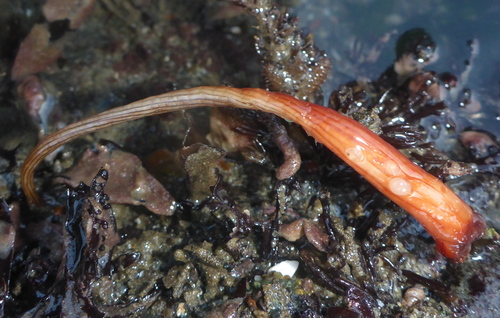
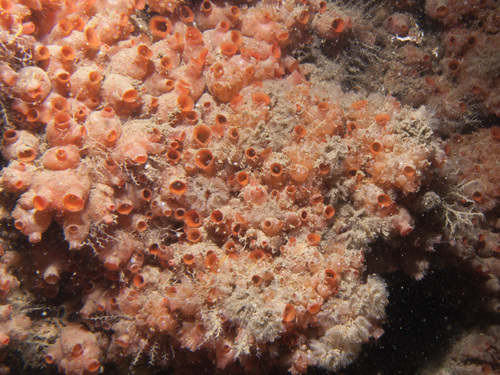
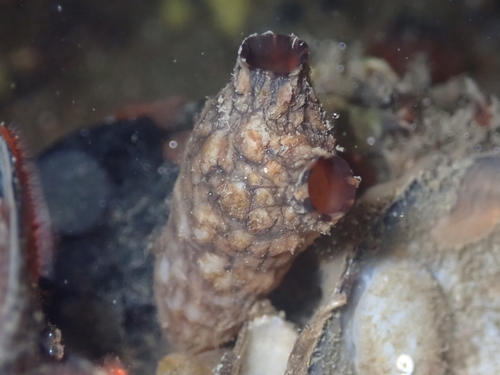
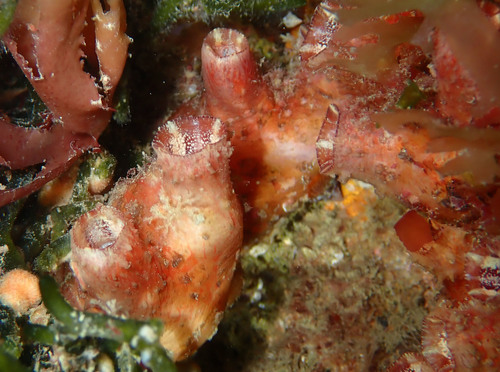
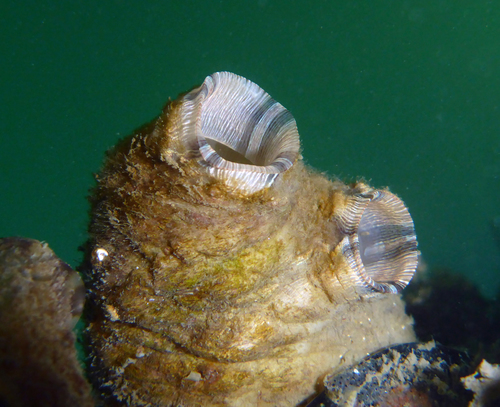
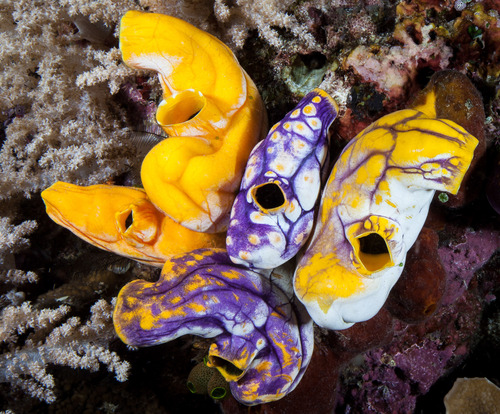
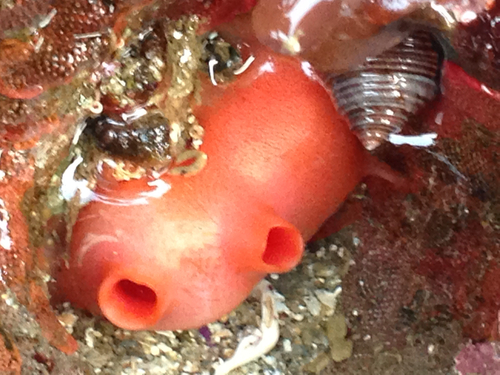
Cnemidocarpa finmarkiensis (Kiaer, 1893) is a stalkless solitary tunicate that adheres to substrates via a broad base, and most often has a hemispherical shape. Its two siphons are positioned far apart; they are conspicuous when expanded, and much smaller when contracted, resembling small crosses. This tunicate rarely grows longer than 3 cm (1.2 in), but can exceptionally reach 5 cm (2 in) in length, with a width of 2.5 cm (1 in). Its tunic is thin but strong, with a smooth, shiny surface. It often has a pearly or opaque appearance, and is typically bright red or pinkish-red, though small individuals are often white. The tunic is made up of 12.4% organic content; more than half of this organic content is cellulose (also called tunicin), and the remainder is protein. This is a coldwater species. It is found in the northern and northeastern Pacific Ocean, is circum-boreal across the Arctic, and in the Pacific Northwest its range stretches from Alaska to Point Conception in California. Its depth range runs from the low subtidal to at least 50 m (160 ft), but it can be found as deep as around 540 m (1770 ft) off the coast of Japan. Like all other tunicates, Cnemidocarpa finmarkiensis is a suspension feeder. Cilia that line the gill slits draw water into its body through the buccal siphon, after which food particles are extracted and filtered water is expelled through the atrial siphon. It is a hermaphrodite that breeds in the summer, with external fertilisation. A symbiotic copepod often lives inside its atrium, and various invertebrates take shelter around the base of the tunicate. One known predator of this tunicate is the rainbow star, Orthasterias koehleri.