About Clytus arietis (Linnaeus, 1758)
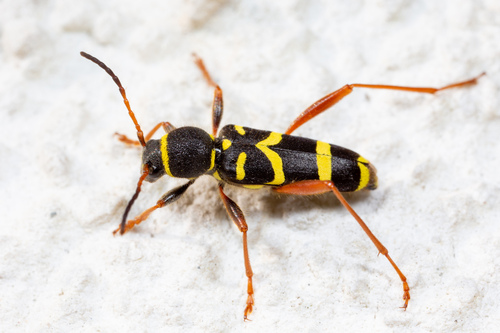
Clytus arietis, commonly called the wasp beetle, reaches 9–18 millimetres (0.35–0.71 in) in body length. This species has prominent yellow and black patterns along its head and abdomen, which is thought to be an evolutionary adaptation to mimic wasps and avoid predation. It also has thin legs and antennae that make small, quick movements, which supports the wasp-mimicking hypothesis. Compared to other beetles in its family, its antennae are relatively short, and most other longhorn beetles have more pointed bodies than this species. A very detailed physical description for species identification is available elsewhere. The wasp beetle shows very little variation in its markings, and colour varieties are extremely rare. Allen (1959) described one colour variant, var. medioniger Allen, which lacks the yellow V-shaped mark on its elytra. More information on this variant can be found elsewhere. Its larvae are small white grubs that develop in deadwood, such as old fence posts. The wasp beetle is widespread across England and Wales, and rare in Scotland. It can also be found throughout Europe, ranging from Portugal to southwestern Russia, and from southern Norway to southern Italy. Its habitat includes farmlands, woodlands, towns, and gardens. Adult wasp beetles may be seen visiting flowers far from any obviously suitable habitat, for example in flower pots located in urban areas. For breeding, it prefers hedgerow vegetation and well-wooded areas. Reproduction begins when adult beetles emerge in spring and lay eggs in deadwood. Research on the sexual behaviour and courtship of Clytus arietis is quite old, with most sources dating to the 1960s. A 1963 paper notes that both male and female wasp beetles produce a "courtship song", but does not provide further explanation. Multiple studies have described male "licking" behaviour during courtship in this species and similar related species. During licking, the male's palps perform a stroking action on the female's back. In some related species, this movement only occurs when the female is restless, leading to the hypothesis that it acts as a calming action. In Clytus arietis, licking is combined with a "tapping" movement: the male rhythmically ducks its head toward the female's thorax in a combined "lick-tapping" action. This movement is very likely meant to stimulate the female, but it remains unclear whether it also stimulates the male, leaving a research gap on this point. During the lick-tapping movement, chemoreceptors in the male's palps receive a concentrated scent from the female. In a few beetle species in the same subfamily Lepturinae, males initiate copulation by mounting females, placing their head over the female's head, grasping one of the female's antennae with their mouthparts, and pulling on the antenna until copulation begins, while the male's abdomen probes down to contact the female's ovipositor. After successful copulation initiation, the male releases the female's antenna and performs the lick-tapping movement to calm the female. Total copulation duration ranges from 10 to 40 minutes, with an average of 20 minutes. Adult wasp beetles feed on pollen, and occasionally feed on small insects. It has been hypothesized that this occasional insect consumption provides extra protein for females to support egg production. The flowers most frequently visited by adult wasp beetles are umbels (family Apiaceae) and dog rose. Larvae feed on dry deciduous deadwood, where they also overwinter.