About Clytra quadripunctata (Linnaeus, 1758)
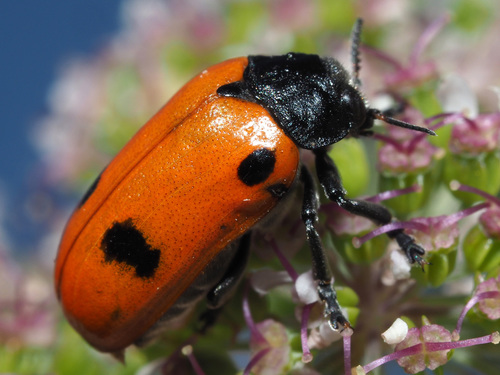
Clytra quadripunctata, first described by Linnaeus in 1758, reaches an adult body length of approximately 8–10 mm (0.31–0.39 inches). Individuals of this beetle species have four black spots on their yellow-red wing covers, also called elytra. This species is very closely similar in appearance to Clytra laeviuscula, but can be distinguished by several consistent traits. Compared to C. laeviuscula, the posterior elytral spots of C. quadripunctata are smaller and more rounded. The key identification feature separating the two species is found on the central area of the pronotum: in C. quadripunctata, the central pronotum is regularly punctate and not shiny, while in C. laeviuscula this area is smooth and shiny. This species occurs across the western Palearctic realm, ranging from Europe (including Bohemia, Moravia, France, Germany, Italy, Slovakia, and northern Spain) east to Mongolia. Its habitats include the edges of forests and roadsides, dry grasslands, and the surfaces of woody plants.