About Clupea pallasii Valenciennes, 1847
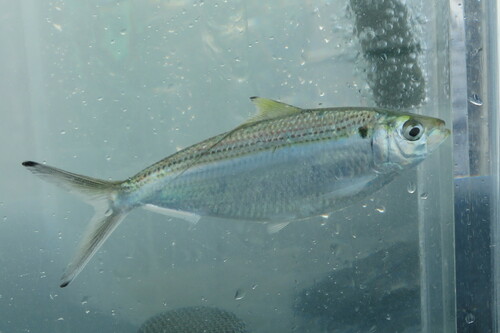
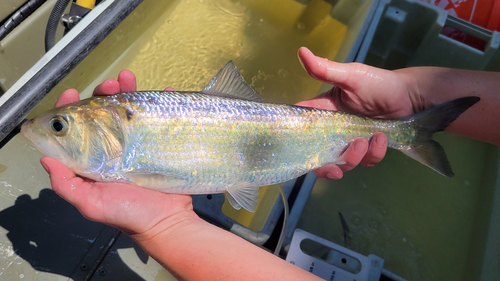
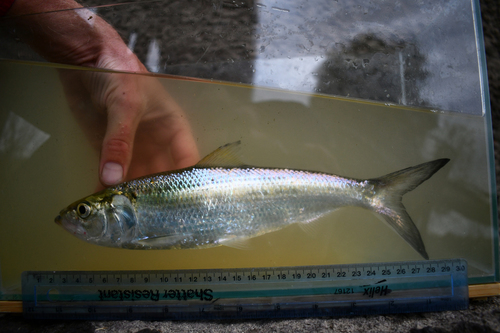
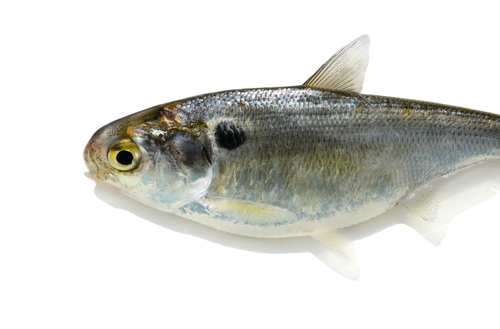
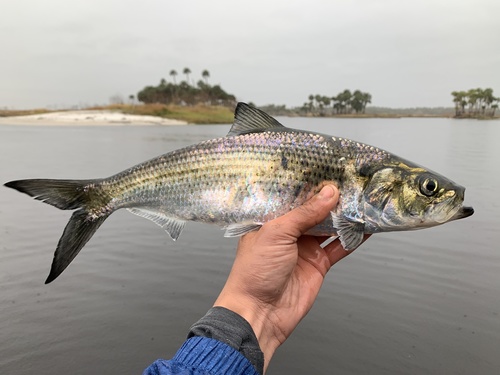
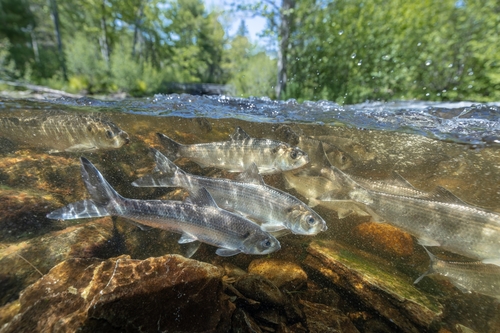
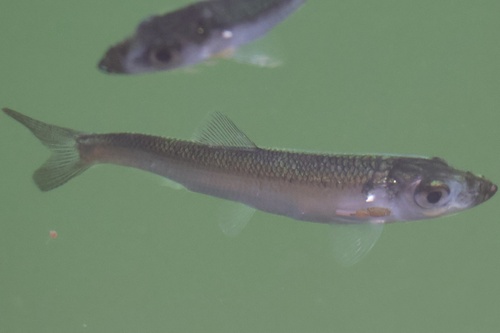
Clupea pallasii, commonly known as Pacific herring, have a distinct morphological profile. They have a bluish-green back, silver-white sides and bellies, with no additional markings. Their silvery color comes from guanine crystals embedded in their lateral skin, which creates an effective camouflage effect. They have a single dorsal fin positioned mid-body and a deeply forked tail fin. Their bodies are compressed laterally, and ventral scales protrude in a slightly serrated pattern. Unlike other members of the Clupea genus, Pacific herring have no scales on their heads or gills, and their existing scales are large and easy to remove. Exceptional individuals can reach 45 centimeters (18 inches) in length and weigh up to 550 grams (19 ounces), but the typical adult size is closer to 33 centimeters (13 inches). The interior of these fish is quite bony, with oily flesh. They have no teeth along their jawline, but do have some teeth on the vomer. Pacific herring have an unusual retinal structure that lets them filter feed in extremely dim environments. They can perform rapid vertical movement, thanks to a complex nerve receptor system that connects to their gas bladder.
For their life cycle, Pacific herring prefer to spawn in sheltered bays and estuaries. Along the American Pacific Coast, the main spawning areas include San Francisco Bay, Richardson Bay, Tomales Bay, and Humboldt Bay. Adult males and females migrate from the open ocean to bays and coves around November or December, though migration may happen later in the northern parts of their range. The exact conditions that trigger spawning are not fully understood. After congregating for weeks in deeper channels, both males and females move into shallower inter-tidal or sub-tidal waters. They prefer to lay their eggs on submerged vegetation, especially eelgrass. A single female can lay up to 20,000 eggs in one spawning event, after making ventral contact with the submerged substrate. Only about one out of every ten thousand eggs survives to become a mature adult, due to heavy predation from many other species. The exact step-by-step process of spawning is not well understood, but some researchers propose that males start the process by releasing milt, which contains a pheromone that stimulates females to begin laying eggs. Spawning is a collective behavior: an entire school can spawn within a few hours, reaching an egg density of up to 6,000,000 eggs per square meter. Fertilized eggs are spherical, measure 1.2 to 1.5 millimeters in diameter, and incubate for approximately ten days in estuarine waters around 10 degrees Celsius. Both eggs and juvenile Pacific herring face heavy predation.