About Clubiona subsultans Thorell, 1875
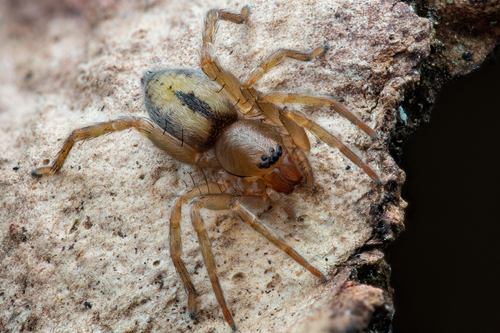
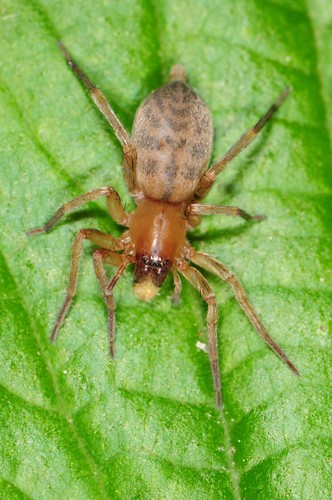
Clubiona subsultans, first described by Thorell in 1875, has different body length ranges for females and males: females measure 5–7 mm, while males measure 5–9 mm. The species' tibial apophysis is pointed and bears two barbs. Its prosoma is golden-brown, chelicerae are brownish, and legs are yellow. The abdomen is reddish brown with yellow spots, and a black median band marked with white arc-lines. This spider typically lives under stones and bark, within moss and litter, most often in coniferous forests. In Britain, it is commonly called the Caledonian sac-spider, because its native habitat is Scots pine forest. It is specifically associated with Caledonian pine woods, where it has been found under bark, on branches, in pine litter, among young pines, and on understorey juniper growing within pine woods. Recently, this species was recorded as the most common spider caught in artificial nestbox traps set out in Abernethy Forest to survey for the bee Osmia uncinata. Adult males and females of this species have been collected in June, and adult males have also been found in September. Clubiona subsultans has a Palearctic distribution. In Europe, it occurs in northern and central Europe. In Great Britain, the species is restricted to relict patches of Caledonian Forest in north-central Scotland, which is the origin of its common name, the Caledonian sac spider.