About Clostera pigra (Hufnagel, 1766)
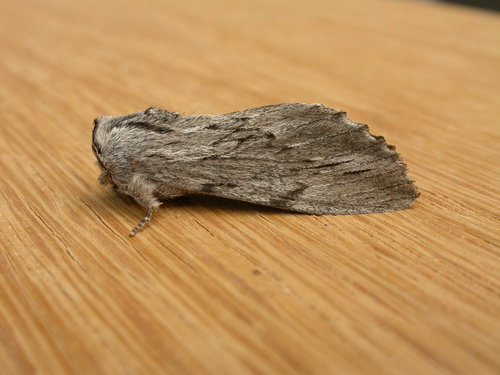
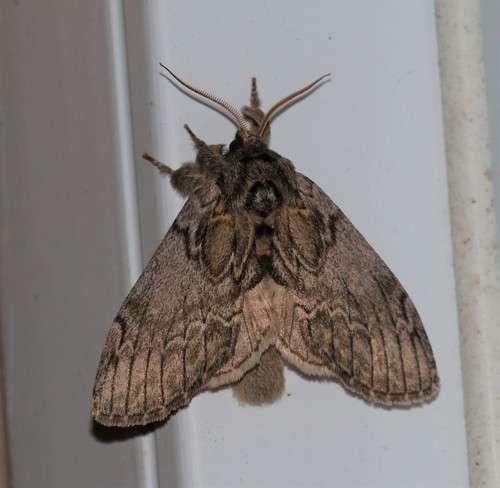
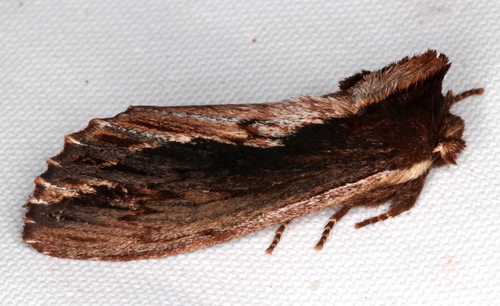
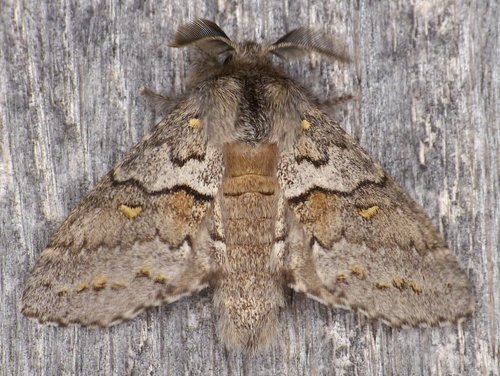
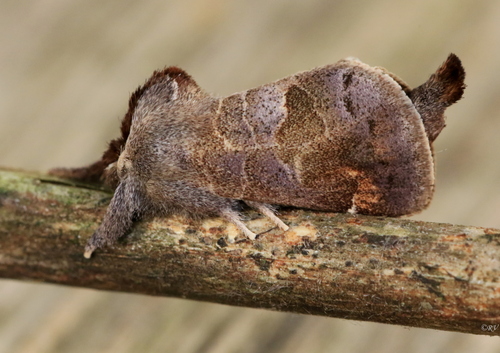
This species is smaller than Clostera anachoreta, with a darker overall base color. Its forewing is strongly suffused from whitish grey to violet grey, particularly in the central area and along the distal margin; the original three bands appear as three distinct, prominent white lines. The subbasal and prediscal bands get closer to each other near the costa, and join together at the hind margin. A red-brown spot sits between the postdiscal band and the wing apex. Two varieties of this species were previously recognized, one lighter and one darker. The darker form, obscurior Stgr., is now classified as the full species Clostera obscurior (Staudinger, 1887); it has a very deep dark brown base color and occurs in Central and East Asia. The lighter form, ferruginea Stgr., has a bright rust-brown base color and was first described from southern Asia Minor. The egg of Clostera pigra is semiglobular and flesh-colored. The larva ranges from ashy grey to blackish grey, sometimes with a greenish tint; its hairs are grey-yellow. The humps on the first and eighth abdominal segments are flat and black. It has two longitudinal rows of small yellow lateral warts set within dark spots, plus an interrupted ventro-lateral yellow double stripe that holds the black spiracles. Larvae feed on Salix and aspen. The pupa is glossy red-brown with dark wing cases, and develops inside a whitish grey web.