About Clonophis kirtlandii (Kennicott, 1856)
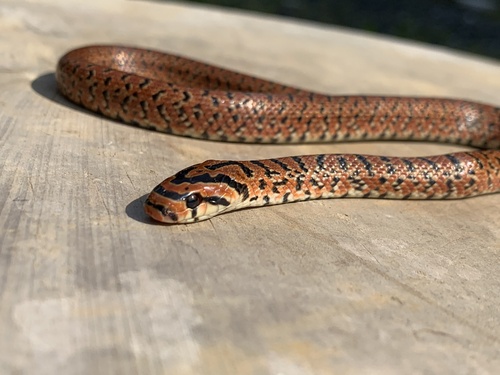
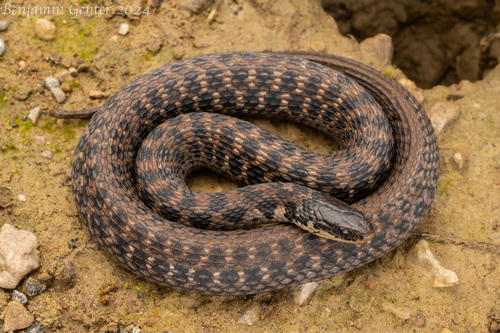
Kirtland's snake, scientifically named Clonophis kirtlandii (Kennicott, 1856), is a small, slender species. Adult individuals reach a total length (including the tail) of 12–18 inches, or 30–46 cm. Its base color is grayish brown, with a double row of large black spots running along its back, and alternating smaller spots along each side. The ventral scales are brick red, with a distinct round black spot at each outer end. At midbody, it has 19 rows of keeled dorsal scales, and its anal plate is divided. Currently, Clonophis kirtlandii is confirmed to live in Illinois, Indiana, Kentucky, southern Michigan, northeastern Missouri, Ohio, and northwestern Tennessee. Historically, this species was also present in Western Pennsylvania, but no individuals have been documented in the state since 1966. The preferred natural habitats of C. kirtlandii are forests, grasslands, and wetlands including swamps and marshes. It is almost always found very near a water source, even though it is less aquatic than water snakes of the genus Nerodia that share its geographic range. Field studies have found that populations occur in areas with abundant grass, herbaceous vegetation, and shrubs during spring. This snake is ovoviviparous. Females give birth between August and September. Brood size ranges from 4 to 22 offspring. Each newborn measures 13–17 cm (5–6¾ inches) in total length, and averages 1.4 gm in weight.