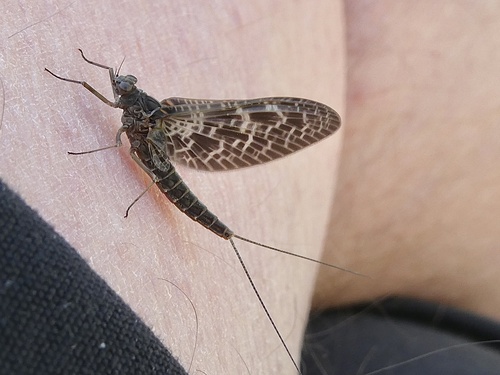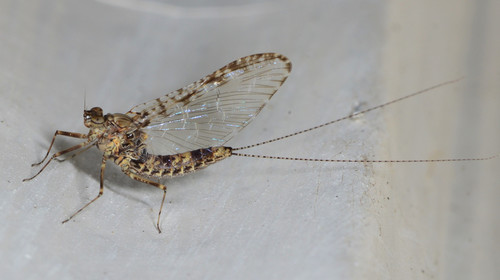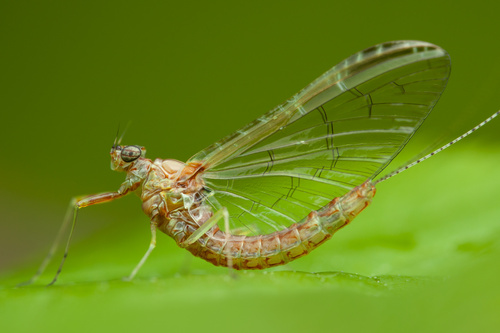
About Cloeon dipterum (Linnaeus, 1761)
Like other species in the genera Cloeon and Procloeon, Cloeon dipterum has only one pair of wings. This trait is reflected in its specific epithet dipterum: the name comes from the Latin di- meaning 'two' and the Greek pteron meaning 'wing'. In his original description of the species, Carl Linnaeus wrote 'Inferiores alæ vix existunt', which translates to 'smaller wings hardly present'. Cloeon dipterum compound eyes have clear sexual dimorphism. Females have lateral apposition eyes, while males have an extra dorsal 'turban-shaped' section on their eyes that functions as superposition eyes. These additional eye structures are thought to help males find isolated females within mating swarms. Cloeon dipterum was first described by Carl Linnaeus in the second edition of his Fauna Suecica. It has an unusually high number of taxonomic synonyms. These include new combinations of Linnaeus's original name placed in different genera: Ephemera, Chloeon, Cloe and Cloeopsis. It also has many true synonyms: three introduced by Otto Friedrich Müller in 1776 (E. annulatum, E. rufulum and E. dimidiatum), one by William Elford Leach in 1815 (C. pallidum), two by John Curtis in 1834 (C. marmoratum and C. obscurum), three by James Francis Stephens in 1835 (C. cognatum, C. consobrinum and C. virgo), one by Jules Pierre Rambur in 1842 (C. affinis), one by Costa in 1882 (C. apicalis), one by Bengtsson in 1940 (C. inscriptum), and one by Jacob in 1969 (C. szegedi). Cloeon dipterum is widespread across Europe and Asia. In the British Isles, it is the most common mayfly found in ponds, occurring in around 40% of all ponds there, and rising to 70% occupancy in the southern part of the British Isles. A single female Cloeon dipterum was first recorded in North America in Illinois in 1953; another individual was found near Lucas, Ohio in 1960. The species is now confirmed to have a wide distribution across North America. Populations previously classified as Cloeon dipterum from Madeira are now reclassified as the separate species Cloeon peregrinator. Cloeon dipterum is unusual among mayflies for being ovoviviparous, and it is the only known ovoviviparous mayfly species in Europe. Females lay eggs 10 to 14 days after mating, and the eggs hatch immediately once they reach the water. Cloeon dipterum larvae can survive for months in anoxic conditions. This is an adaptation that allows them to survive winter in frozen-over ponds that have very low levels of dissolved oxygen. In captive conditions, adult females of the species have been kept alive for up to three weeks.