About Clitoria mariana L.
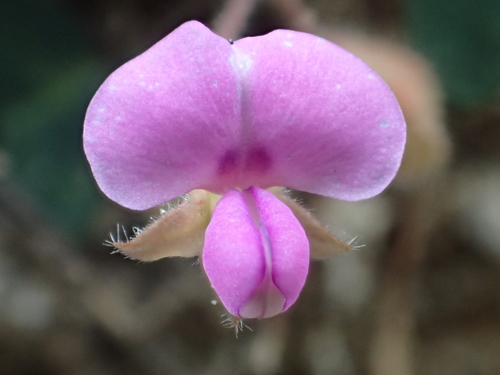
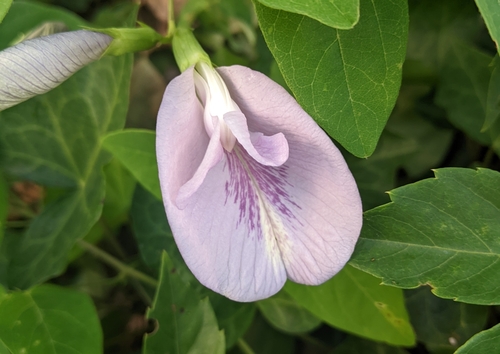
Clitoria mariana L. has ascending stems that sometimes twine, and grow 45 to 60 centimeters long. Its leaves are pinnately trifoliate, borne on petioles with stipules. The leaflets are thin, smooth or slightly hairy, ovate in shape, 2.5 to 11 centimeters long, and 1.5 to 5 centimeters wide. The species produces purple, axillary, usually solitary, resupinate flowers during summer. The calyx is tubular, and the corolla is about 5 centimeters long, with its wings and keel much shorter than the standard. Its fruit is a linear oblong pod that measures 25 millimeters long and 5 millimeters wide. This species looks similar to Centrosema virginianum, but can be distinguished by flower orientation: Clitoria mariana flowers are erect, while Centrosema virginianum flowers are upside down, with the banner pointing downward. Clitoria mariana is native to the eastern, southern, and central United States, ranging west to New Mexico and Arizona. In the United States, it has been recorded in Alabama, Arkansas, Arizona, Washington, D.C., Delaware, Florida, Georgia, Iowa, Illinois, Indiana, Kansas, Kentucky, Louisiana, Maryland, Minnesota, Missouri, Mississippi, North Carolina, Nebraska, New Jersey, New Mexico, New York, Ohio, Oklahoma, Pennsylvania, South Carolina, Tennessee, Texas, Virginia, Wisconsin, and West Virginia. It is also found in Asia, specifically in Bhutan, India, Laos, Myanmar, Thailand, Vietnam, and southern China (Guangxi, Yunnan). Clitoria mariana is a facultative upland species. It typically grows in high light areas, but can also tolerate partial shade, and grows in dry to moist sandy soils. In ecology, it acts as a larval host plant for the long-tailed skipper.