About Clitarchus hookeri (White, 1846)
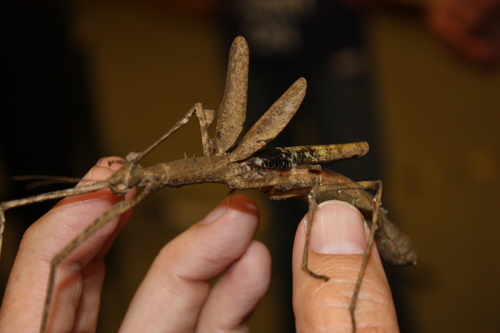
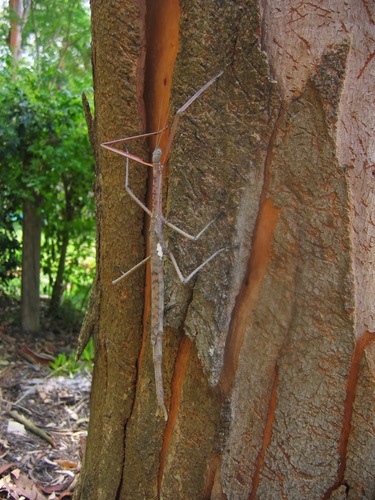
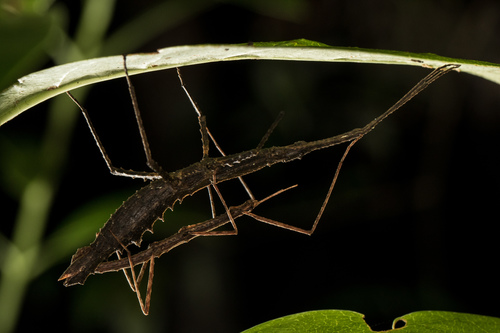
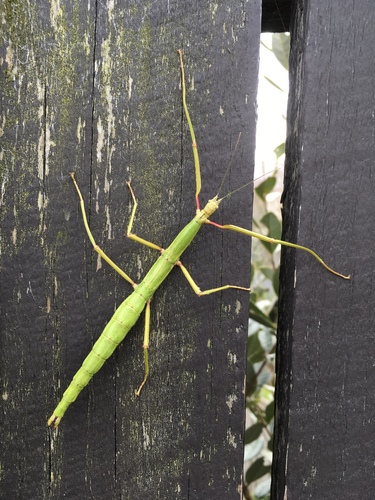
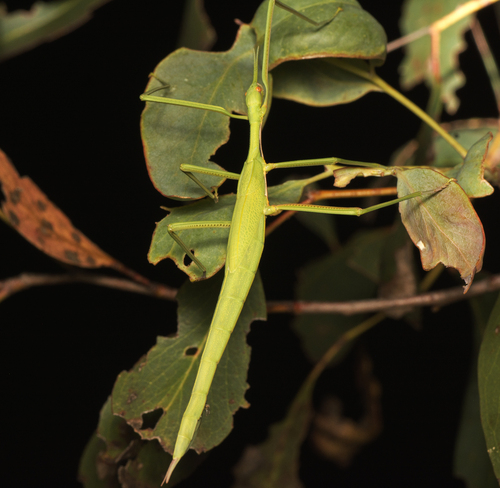
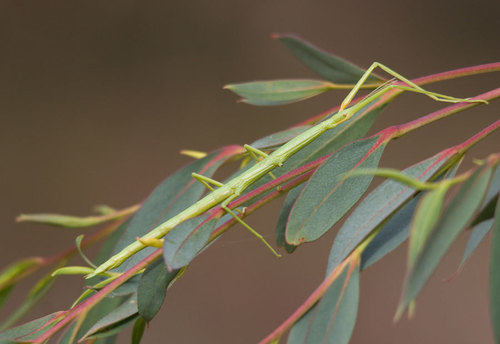
Clitarchus hookeri (White, 1846) is a large species of stick insect that displays sexual dimorphism. Adult females grow between 81 and 106 millimetres long, while adult males grow between 67 and 74 millimetres long. Their body colour is highly variable, even among individuals found in the same location, and ranges from bright green to grey, brown, or buff. This colour variation is thought to be genetically determined, rather than caused by environmental factors. Unlike many tropical stick insect species, Clitarchus hookeri is flightless. In New Zealand, Clitarchus hookeri is distributed from Northland down to the Wellington region in the south of the North Island. In the South Island, it is not as widespread, and occurs mainly in eastern coastal areas from northern Nelson and Marlborough, through Canterbury, to its southern limit at Dunedin. This species has also been introduced to Great Britain, where the entire established population is all-female, and descended from a sexual population originally from Taranaki, New Zealand. Clitarchus hookeri is most commonly associated with mānuka, but has also been observed feeding on kānuka, pōhutukawa, Muehlenbeckia australis, roses, white rātā, and Coprosma. Clitarchus hookeri is hemimetabolous: nymphs go through six successive instar stages before undergoing a final moult to reach their adult form. Adults are active during the summer months and are mostly active at night. During the day, they hide among the branches of their host trees, and emerge at sunset to feed and mate. Females hang from the edges of branches to feed on host plant leaves, and signal to males by releasing a mixture of volatile chemicals. Adult males, which have long legs, move around at night to search for mates. Males court females by resting their forelegs across the female’s body for between 10 minutes and 1 hour. After courtship, the male climbs onto the female and attempts to clasp her subgenital plate with his genital claspers. If the male attaches successfully, mating begins when the female’s operculum opens and the male inserts his genitalia. Males stay attached to females for extended periods that last from 1 to 10 nights, and may mate multiple times during this attachment. Clitarchus hookeri has geographically structured parthenogenesis, meaning that in some localities, females can produce fertile eggs without mating to reproduce. In sexual populations, all eggs produced after mating are the result of sexual reproduction. In the South Island of New Zealand, males of this species are rare or completely absent, while both asexual and sexual populations exist in the North Island. Asexually reproducing females lay a similar number of eggs, and have similar hatching success, compared to sexually reproducing females, but their eggs take longer to hatch. Eggs from parthenogenetic females take between 21 and 23 weeks to hatch, while eggs from mated females take between 9 and 16 weeks to hatch. In captive settings, females from parthenogenetic populations have a natural barrier to fertilization even when provided with mates, though males are unable to distinguish between sexual and parthenogenetic females. Despite this, two wild populations in New Zealand have very recently reverted to sexual reproduction.